

Tesamorelin is a synthetic version of growth hormone-releasing hormone (GHRH), the natural signal your brain sends to the pituitary gland to release growth hormone. It’s a GHRH analog, meaning it mimics that signal with a slightly modified structure that lasts longer in the body. If you’re looking to buy tesamorelin for laboratory research, understanding what the science does and doesn’t say is the right place to start. In clinical settings, it’s best known as an FDA-approved treatment for excess abdominal fat in adults with HIV-associated lipodystrophy, and researchers continue to study it in other areas, from liver fat to metabolic health.
That’s exactly what this overview covers. You’ll find a plain-language look at how tesamorelin works, how it compares with related GHRH peptides, and where the research stands today.
If you write about health and science, topics like this are a real opportunity. Readers are hungry for clear, trustworthy explanations, and writers who can turn dense studies into friendly, accurate copy are always in demand. Stick with it, and you’ll build the confidence to tackle these subjects like a pro.
What Tesamorelin Means in Plain Language
Tesamorelin is a lab-made version of a hormone-releasing signal that your body already produces. In research circles, it’s called a GHRH analog, which simply means it’s built to resemble growth hormone-releasing hormone, the natural messenger that tells the pituitary gland (a pea-sized gland at the base of the brain) to release growth hormone.
Think of it like a spare key cut from an original. The copy isn’t identical in every detail, but it’s shaped to fit the same lock. Scientists tweaked the original design so the copy lasts longer in the body than the natural signal does, which makes it easier to study.
Tesamorelin belongs to a large family called peptides, which are short chains of amino acids, the same small building blocks that make up proteins. Many hormones are peptides, so this family is a familiar neighbourhood in health and science writing.
A quick glossary can help you keep the key terms straight:
- Tesamorelin
- A synthetic peptide designed to mimic the body’s natural growth hormone-releasing hormone. It has been studied in published clinical research.
- GHRH
- Short for growth hormone-releasing hormone, a natural signal that prompts the pituitary gland to release growth hormone.
- Analog
- A modified copy of a natural substance, made to act in a similar way while being easier to study or longer-lasting.
- Peptide
- A short chain of amino acids. Peptides act as messengers and building blocks throughout the body.
- Growth hormone
- A hormone made by the pituitary gland that plays a role in growth, metabolism, and body composition.
- IGF-1
- Insulin-like growth factor 1, a substance the liver produces in response to growth hormone. Researchers often measure it as a marker of growth hormone activity.
One important note before we go further: this article is an overview of published research, written to help you understand the topic. It isn’t medical advice, and it shouldn’t replace a conversation with a qualified health professional.
How Tesamorelin Works: The Science Made Simple
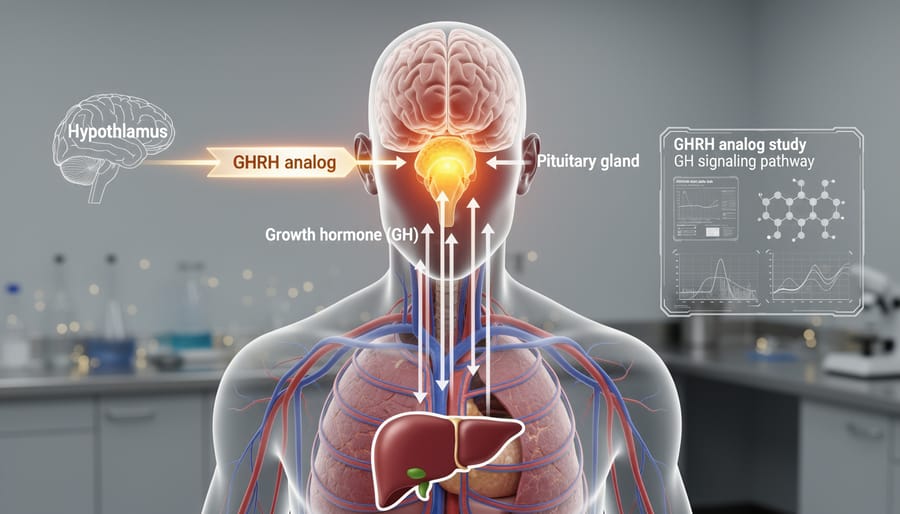
Think of your body’s hormone system as a chain of messages. The hypothalamus, a small control center in the brain, sends a signal called growth hormone-releasing hormone, or GHRH. That signal travels to the pituitary gland, a pea-sized gland at the base of the brain, and tells it to release growth hormone into the bloodstream. Tesamorelin is a synthetic analog, meaning a lab-made lookalike of GHRH, designed to deliver that same “go” message.
Here’s where the concept gets interesting. Giving someone growth hormone directly supplies the finished product from outside the body. A GHRH analog works one step earlier. It nudges the pituitary to release growth hormone it already makes, using the body’s own production line. Published research describes this as a more “upstream” approach, and it matters because the body’s natural feedback systems stay in the picture. Growth hormone normally rises and falls in pulses, and researchers have been curious about whether signalling the pituitary preserves more of that natural rhythm than supplying the hormone directly.
Once growth hormone is released, the liver responds by producing another messenger called insulin-like growth factor 1, or IGF-1. Many studies track IGF-1 levels as a way of measuring how strongly the signal was received. If you’re writing about this, that’s a handy detail: scientists often follow the downstream markers rather than watching growth hormone itself, since it comes in short bursts.
A useful tip for your own writing: when a concept has two steps, like signal and response, explain them in order, just as you would a simple recipe. Readers follow the logic easily, and you’ll sound confident without leaning on heavy jargon.
Types and Components: Tesamorelin’s Building Blocks and Related GHRH Peptides
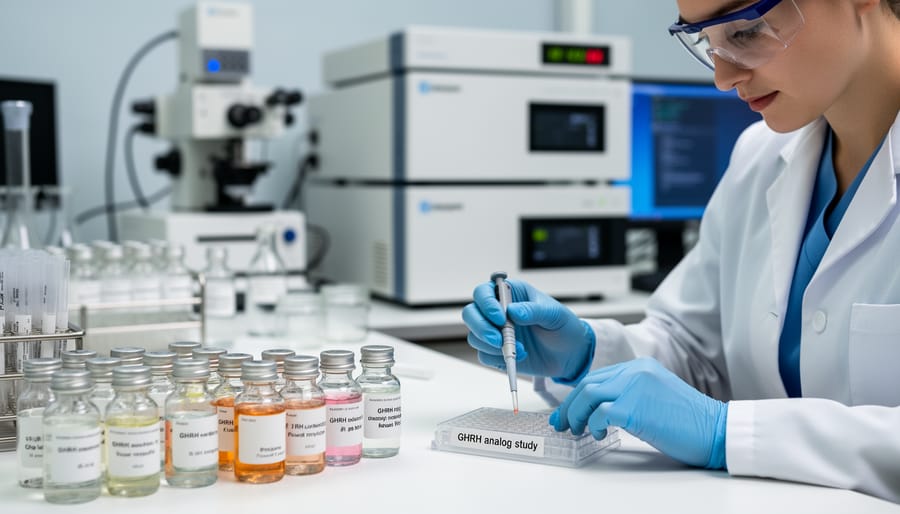
Tesamorelin is built from a chain of 44 amino acids, which makes it a peptide in the same broad family as the hormone your body already makes. Natural GHRH has the same 44-unit chain. The difference lies in one tweak at the front end: researchers describe a small chemical group called a trans-3-hexenoyl group attached to the start of the chain. According to published literature, that addition is meant to help the molecule resist the enzymes that would otherwise break it down quickly, so it lasts longer in the body than the natural hormone does.
In clinical studies, tesamorelin has been described as a lyophilized (freeze-dried) powder that is reconstituted with liquid before use. That detail matters for writers because it shows up in prescribing and regulatory documents, and it’s easy to get wrong if you only skim summaries.
You’ll often see tesamorelin mentioned alongside other peptides in the same family. Here’s a descriptive snapshot of how they relate:
- Natural GHRH: the body’s own 44-amino-acid signal, which breaks down quickly and is the template for all the analogs below.
- Tesamorelin: a full-length, stabilized version of GHRH, modified at the start of the chain to last longer.
- Sermorelin: a shorter fragment containing only the first 29 amino acids of GHRH, without tesamorelin’s stabilizing group.
- CJC-1295: a modified GHRH fragment that appears in research literature in versions with and without a feature intended to extend its time in the body.
- Growth hormone itself: not a GHRH analog at all, since it is the end product that these peptides are studied for signalling the body to release.
Keep in mind that sermorelin and CJC-1295 are discussed in different regulatory and research contexts than tesamorelin, so it’s worth checking each one’s primary sources separately. Describing how the molecules differ in structure is solid, defensible territory. Comparing how well they work is where you’d want published head-to-head data, and that isn’t something to assume or imply.
How Tesamorelin Is Used in Research and Clinical Settings
Tesamorelin’s best-documented use comes from research on HIV-associated lipodystrophy, a condition where people living with HIV develop excess abdominal fat, often as a side effect of long-term antiretroviral therapy. According to published clinical trials, tesamorelin was studied in this group specifically for its effect on visceral fat, the deeper abdominal fat surrounding the organs. Those studies fed into the regulatory review process, and the peptide went on to receive approval from the U.S. Food and Drug Administration for this particular indication. If you’re writing about it, the regulatory pages and the original trial publications are the places to confirm exact wording and dates.
Beyond that approved use, researchers have explored tesamorelin in several other investigational areas. Published studies and registered clinical trials have looked at its relationship to body composition, metabolic markers, and liver fat in different populations. There has also been scientific curiosity about its possible links to cognitive function in aging, since the growth hormone pathway interacts with many body systems. It’s worth stressing that much of this work is early-stage, involves small groups, or remains unresolved. Interest in a question isn’t the same as an established answer.
A helpful way to frame it for readers is to separate three things clearly: what has been reviewed by regulators, what has been reported in peer-reviewed studies, and what is still being explored. Keeping those categories distinct protects your credibility and your readers’ understanding.
This section is a summary of published research, not medical guidance. Anyone wanting specifics about how tesamorelin is used, who it’s appropriate for, or what the evidence shows in detail should consult the primary sources directly, such as peer-reviewed journals, regulatory agency listings, and clinical trial registries, and speak with a qualified health professional.
Writing About Tesamorelin and Peptide Research With Confidence

Writing about peptide research is very doable when you build good habits. Start with primary sources: peer-reviewed journals on PubMed, regulatory agency pages such as Health Canada and the U.S. FDA, and clinical trial registries like ClinicalTrials.gov. Read the study’s methods and limitations, not just the abstract, and name the study type so readers know how much weight a finding carries.
Interviews help too. A short conversation with a pharmacist, physician, or researcher can turn dense material into something clear, and it supports your E-E-A-T SEO goals by showing real expertise behind your words. Keep claims modest, say “researchers observed” instead of “it proves,” and skip anything that sounds like medical advice.
Careful fact-checking before you submit protects both you and your client. A clean blog structure with short sections and plain definitions makes technical topics easier to follow.
Here’s an illustrative example. Picture a writer who took one science assignment, kept a simple source log, and always asked an expert to review tricky passages. Editors noticed the accuracy, and within a year she had steady monthly work. If you want to build a similar niche, our guide to health writing in Canada is a great next read.
Common Questions About Tesamorelin
Readers tend to arrive at this topic with the same handful of questions, and clear, honest answers go a long way toward building trust. Here are the ones that come up most often, answered in plain language and grounded in what published research actually supports.
What is tesamorelin in simple terms?
Tesamorelin is a lab-made version of growth hormone-releasing hormone (GHRH), a natural signal that prompts the pituitary gland to release growth hormone. It’s described as a GHRH analog because it mimics that signal.
How is it different from growth hormone itself?
Growth hormone is the end product, while tesamorelin is understood to act one step earlier by nudging the body to release its own. That’s a conceptual difference, and it doesn’t mean the two behave identically.
Is tesamorelin a hormone or a peptide?
It’s a peptide, meaning a short chain of amino acids, designed to behave like a hormone-releasing signal. Many hormones are peptides, so the labels overlap.
Where can readers find reliable research?
Start with peer-reviewed journals, regulatory agency pages, and clinical trial registries. These show what has been studied, in whom, and what remains unproven.
If you’re writing about this topic, notice what these answers have in common: they stay specific and avoid promising more than the evidence delivers. Readers appreciate that honesty, and it’s a habit that makes every health and science assignment easier to approach with confidence.
Tesamorelin is a synthetic version of GHRH, a naturally occurring signal that prompts the pituitary gland to release the body’s own growth hormone. That’s the heart of it. Researchers have studied it most closely in HIV-associated lipodystrophy, and interest in other areas continues to develop through ongoing investigation.
If you take one thing from this overview, let it be the approach. Start with a clear definition, explain the mechanism in everyday terms, and keep every claim tied to a primary source. Peer-reviewed journals, regulatory agency pages, and trial registries will carry you a long way.
Health and science topics can feel intimidating at first, but they get easier with each assignment you tackle. Stay curious, double-check your sources, and trust your ability to translate complicated ideas for real readers. With the right preparation, even the densest subject becomes a chance to show what you can do.