

Transform a single blog post into a YouTube script by extracting your main points and restructuring them as a conversational narrative with visual cues. Record yourself presenting the content, adding personal anecdotes that weren’t in the original piece to create fresh value for video audiences.
Convert your long-form articles into carousel posts for LinkedIn or Instagram by identifying 5-7 key takeaways and designing each as a standalone slide with a bold headline and supporting detail. This format performs exceptionally well for freelance writers building their personal brand, as each slide becomes shareable content that drives traffic back to your original work.
Break down comprehensive guides into email newsletter series by dividing the content into logical segments that deliver value over multiple sends. Each email should stand alone while creating anticipation for the next installment, allowing you to maintain consistent engagement with subscribers without constantly creating new material from scratch.
Repackage industry insights and how-to content into downloadable PDF checklists or templates that serve as lead magnets. Canadian freelancer Sarah Mitchell grew her client list by 40% in six months by converting her best-performing blog posts into practical worksheets that demonstrated her expertise while capturing email addresses of potential clients.
Extract compelling quotes and statistics from your research-heavy articles to create quote graphics for social media platforms. These bite-sized pieces position you as a thought leader and drive curious readers to explore your full content library, multiplying the return on your initial writing investment without requiring additional research time.
Why Canadian Freelancers Need Content Repurposing in Their Toolkit
As a Canadian freelance writer, you’re already familiar with the flexibility and freedom that comes with being your own boss. But here’s the exciting part: content repurposing can amplify everything you love about freelancing while solving some of its biggest challenges.
Let’s start with the financial benefit. When you repurpose one piece of content into multiple formats, you’re essentially creating several income streams from a single project. That blog post you wrote? Transform it into a LinkedIn carousel, podcast script, or email series. Suddenly, you have multiple products to pitch to different clients or platforms. This approach helps you work smarter, not harder, maximizing your earning potential without doubling your workload.
Repurposing also expands your audience reach dramatically. Not everyone consumes content the same way. Some readers prefer quick social media tips, while others want in-depth articles or video tutorials. By adapting your content across formats, you meet your audience where they are. This versatility makes you more valuable to clients who need multi-platform strategies.
Building authority becomes easier too. When people encounter your insights on LinkedIn, then see your byline in a newsletter, and later watch your video on the same topic, you become memorable. This consistent presence positions you as an expert in your niche, leading to better-paying opportunities and more referrals.
Perhaps most importantly, content repurposing supports the work-life balance you sought when choosing freelancing. Instead of constantly chasing new ideas or burning the midnight oil on fresh content, you’re strategically leveraging what you’ve already created. This sustainable approach prevents burnout while keeping your content pipeline full.
For Canadian freelancers navigating seasonal market fluctuations or building their client base, repurposing offers stability. You’re not starting from scratch each time, which means more predictable income and less stress. It’s a toolkit essential that aligns perfectly with the freelance lifestyle you’ve chosen.
The Core Strategy: Turning One Piece into Many
Here’s the thing about content repurposing: you’re not doing extra work—you’re simply being smarter with the work you’ve already done. The core strategy is beautifully simple: create one strong piece of foundational content, then strategically adapt it into multiple formats that serve different audiences and platforms.
Think of your best-performing blog post, in-depth article, or client project. That single piece contains enough value to fuel an entire content ecosystem. A 2,000-word article can become a LinkedIn carousel, three Twitter threads, an email newsletter, a YouTube script, podcast talking points, and Instagram story highlights. You’ve done the research once, crafted the key messages once, and now you’re maximizing that investment.
The mindset shift here is crucial. Stop thinking in terms of isolated pieces and start seeing content as interconnected assets. When you’re researching and writing that foundational piece, you’re not just completing one assignment—you’re building a content library that will serve you across multiple income streams and client relationships.
This approach transforms how you value your time. Canadian freelancer Sarah Martinez shared that once she adopted this strategy, her effective hourly rate doubled. She wasn’t working more hours; she was extracting more value from each hour invested in content creation.
The beauty of a platform-ready content strategy is that it’s scalable. Whether you’re just starting out or managing multiple clients, the principle remains the same: create once, adapt strategically, publish everywhere. Your expertise deserves to reach audiences wherever they prefer to consume content, and repurposing makes that possible without burning out.

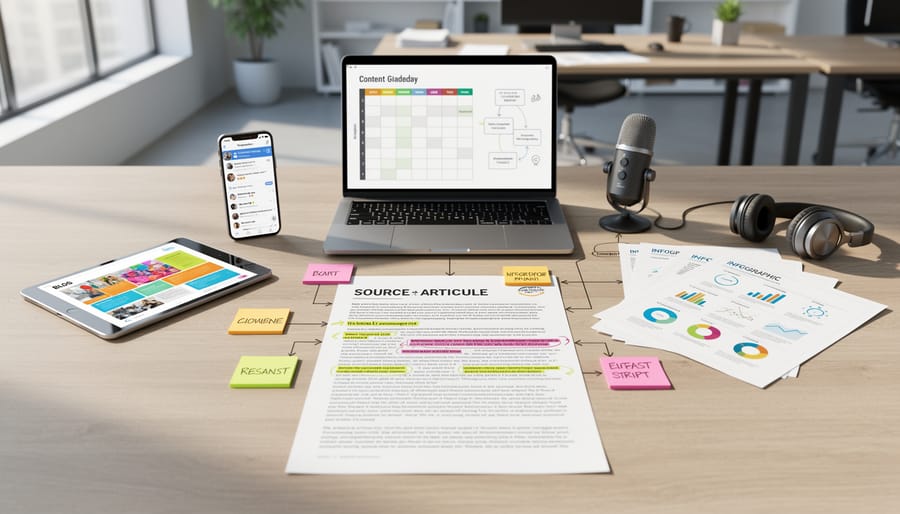
Format Transformations That Work for Writers
From Long-Form Article to Social Media Series
Your long-form blog posts contain multiple valuable ideas that can fuel weeks of social media content. Start by identifying the key takeaways from your article—typically three to five main points that stand independently. Each of these becomes a separate social media post.
For Twitter threads, extract a compelling statistic or question from your article as the opening tweet, then break down one main concept across 5-7 tweets. Keep each tweet conversational and end with a call-to-action linking back to your full article.
LinkedIn posts work beautifully for sharing professional insights. Take one section of your article and reframe it as a mini-lesson or personal reflection. Add context about why this topic matters to your audience and encourage discussion in the comments.
Instagram carousels transform article subheadings into visual slides. Create 6-10 slides featuring one tip per slide with supporting text. Use simple graphics or text-based designs that reflect your brand. This approach to adapting content for platforms helps you reach different audiences while reinforcing your expertise.
The beauty of this strategy is efficiency. One 1,500-word article can generate 15-20 social posts across platforms, extending your content’s lifespan and attracting new readers back to your original work.
From Written Content to Video Scripts and Podcasts
Your blog posts and articles already contain the foundation for engaging video scripts and podcast episodes. The key is adapting your written voice for spoken delivery without losing what makes your content uniquely yours.
Start by identifying high-performing articles that sparked conversations or received positive feedback. These naturally translate well to audio-visual formats. Read your content aloud and mark sections that feel conversational—these become your script anchors. For videos, break longer articles into series, creating bite-sized episodes that maintain viewer attention.
When adapting for podcasts, embrace a more personal tone. Add anecdotes, pause for emphasis, and imagine you’re chatting with a friend over coffee. Your authentic voice matters more than perfect polish. Toronto-based freelancer Maria Chen successfully transformed her career advice articles into a weekly YouTube series, tripling her audience reach within six months while maintaining her supportive, down-to-earth style.
Remember that video and audio formats invite personality. Include vocal variety, share personal experiences, and don’t be afraid to expand on points that deserved more depth in written form. Your written content provides the structure; your spoken delivery brings it to life. This approach helps you connect with audiences who prefer listening or watching over reading, multiplying your impact without creating entirely new material.
From Blog Posts to Email Newsletters and Courses
Your blog posts contain valuable insights that can fuel multiple touchpoints with your audience. By transforming a single article into an email newsletter series, you create consistent engagement while showcasing your expertise in digestible formats.
Start by breaking down a comprehensive blog post into 3-5 email instalments. Each email should focus on one key takeaway, making the content easier to consume during busy mornings. For example, Toronto-based freelance writer Maya Chen transformed her 2,000-word guide on pitching into a five-part email course that attracted 300 new subscribers in three months and led to four new client contracts.
Newsletter content feels more personal and direct than blog posts. Add a conversational opening, address your readers directly, and include a call-to-action that encourages replies. This two-way communication builds relationships that turn readers into clients.
Consider creating mini email courses from your most popular articles. Package the content with worksheets, templates, or checklists as bonus materials. These lead magnets demonstrate your expertise while growing your email list, which becomes a valuable asset for promoting your services. The beauty of this approach is that you’re not creating from scratch—you’re simply reshaping content you’ve already invested time developing.
From Research to Multiple Client Deliverables
One of the smartest moves you can make as a freelance writer is turning a single research project into multiple income streams. When you dive deep into industry data, expert interviews, or market analysis for one client, you’re sitting on a goldmine of material that can serve several projects.
Start by organizing your research findings into themes or key takeaways. That comprehensive interview with an industry expert? The insights can become the foundation for a client case study, while the statistical data works perfectly for an industry report. The background research might fuel a whitepaper for a different client in the same sector.
Consider this approach: After completing research for a technology client’s blog series, Toronto-based freelancer Maya repurposed her findings into three additional deliverables. She created a condensed case study highlighting implementation results, transformed trend data into an infographic-ready report for another client, and used expert quotes to strengthen a whitepaper she was developing. This strategy tripled her return on the initial research investment.
The key is maintaining clear boundaries around proprietary client information while leveraging general industry knowledge, publicly available data, and broad insights. Always ensure you’re not violating confidentiality agreements, and when possible, negotiate rights that allow you to reuse non-sensitive research findings. This ethical approach to content repurposing helps you work smarter while delivering fresh, well-researched content to every client.
From Individual Posts to Ebooks and Lead Magnets
You’ve already done the hard work of creating valuable content—now it’s time to package it strategically. Compiling your best-performing blog posts into ebooks or downloadable guides transforms scattered insights into powerful lead magnets that attract potential clients and build your authority.
Start by grouping 5-10 related articles around a single theme. If you’ve written multiple posts about email marketing, social media strategy, or freelance pricing, you’ve got the foundation for a comprehensive guide. Add a cohesive introduction, smooth transitions between sections, and a compelling conclusion to create a polished product.
These ebooks serve double duty for Canadian freelancers. Use them as free downloads on your website to grow your email list, or sell them as digital products on platforms like Gumroad for passive income. Many writers successfully offer industry-specific guides—like “The Complete Guide to Writing for Canadian Tech Startups”—that showcase their expertise while generating leads.
The beauty of this approach? You’re not starting from scratch. You’re simply reorganizing content you’ve already created into a format that delivers concentrated value. One writer turned her year’s worth of LinkedIn articles into three ebooks, landing two retainer clients who discovered her through those downloads.
Real Success Story: How One Canadian Writer Tripled Her Income
Meet Sarah Chen, a Toronto-based freelance writer who was struggling to make ends meet two years ago. Like many writers starting out, she was constantly chasing new clients and felt stuck on an exhausting hamster wheel of pitching and producing content from scratch. Her income plateaued at around $2,500 per month, and burnout was becoming a real threat.
Everything changed when Sarah discovered content repurposing. She started with a single well-researched article about sustainable living that she had written for a lifestyle magazine. Instead of moving on to the next project, she asked herself: “How else can I use this work?”
Within six weeks, Sarah had transformed that one 2,000-word article into nine different content pieces. She turned key statistics into an infographic that she sold to three different publications. She extracted quotes and created a series of LinkedIn posts that attracted two new corporate clients. She recorded herself reading sections of the article as a podcast episode, which led to speaking opportunities. She even rewrote the content as an email newsletter series that helped her build a subscriber list of engaged readers.
The results were remarkable. Within six months, Sarah’s monthly income jumped to $5,200. By the end of her first year using repurposing strategies, she was consistently earning $7,500 per month while actually working fewer hours.
Sarah’s biggest lesson? Stop thinking of each project as a one-and-done transaction. She now spends 20 percent of her time repurposing existing content and has built a system where every major article she writes generates at least three additional income opportunities. Her advice to fellow Canadian writers is simple: the content you’ve already created is your goldmine. You just need to learn how to mine it effectively.

Your Step-by-Step Repurposing Workflow
Ready to transform your existing content into multiple income streams? Here’s a simple workflow you can start using today.
First, audit your content library. Look through your published articles, blog posts, and client work samples (ones you have rights to repurpose). Identify pieces that performed well, received positive feedback, or contain evergreen information. Your top performers are gold mines waiting to be rediscovered.
Next, match content to formats. Take that popular article about writing techniques and consider which formats would work best. Could it become a helpful infographic for Pinterest? A video script for YouTube? A series of LinkedIn posts? Choose 2-3 formats that align with where your target audience spends time.
Now create a repurposing schedule. Rather than overwhelming yourself, commit to repurposing one piece per week. Block out specific time in your calendar—maybe Friday afternoons become your repurposing power hours. Batch similar tasks together for efficiency.
Track your results using a simple spreadsheet. Note which original pieces you’ve repurposed, into what formats, where you’ve published them, and how they perform. This data-driven content strategy helps you identify what resonates with your audience and guides future repurposing decisions.
Finally, build a repurposing template library. Save formatting templates for social posts, email newsletters, and other frequent formats. This speeds up your workflow considerably.
Remember, repurposing isn’t about perfection—it’s about working smarter. Start small, refine your process, and watch your content work harder for you across multiple platforms.
Common Pitfalls and How to Avoid Them
Even experienced writers stumble when repurposing content. Let’s explore the most common mistakes and how you can sidestep them to make your repurposing efforts truly successful.
The biggest pitfall? Simply copying and pasting content without adapting it for the new format. A blog post won’t work as a LinkedIn carousel without breaking it into digestible slides with visual hierarchy. Your audience expects platform-native content, and lazy repurposing shows. The fix is straightforward: treat each format as a fresh creative challenge. Ask yourself how the content needs to transform to shine in its new home.
Another frequent mistake is ignoring platform-specific best practices. Instagram thrives on stunning visuals and brief captions, while Medium readers expect in-depth storytelling. Take time to understand where your audience hangs out and what they expect there. Study top performers in each space and note what resonates.
Outdated information can seriously damage your credibility. Before repurposing older content, fact-check every statistic, update examples, and refresh links. This is especially important for Canadian writers covering industry trends or market rates that shift regularly.
Finally, many writers forget to optimize for discoverability. Each platform has different search algorithms and tagging systems. On YouTube, compelling thumbnails matter. On Pinterest, keyword-rich descriptions drive traffic. Don’t just repurpose the content itself—repurpose your SEO strategy too.
The good news? Once you recognize these pitfalls, they’re easy to avoid. Build a simple checklist for each repurposing project: adapt the format, respect platform culture, update information, and optimize for discovery. You’ll create content that feels fresh and purposeful every time.
Tools and Resources to Streamline Your Repurposing
You don’t need expensive software to start repurposing your content effectively. Many tools that help writers are either free or budget-friendly, making them accessible regardless of where you are in your freelancing journey.
For content organization and planning, try Trello or Notion. Both offer free versions perfect for tracking your original content and mapping out repurposing opportunities. Create boards for each piece you write, then add cards for potential formats and platforms. Google Sheets works beautifully as a simple content calendar too.
When converting formats, Canva’s free plan lets you transform written content into eye-catching social media graphics, infographics, and presentations. For video content, Loom offers free screen recording, ideal for turning how-to articles into video tutorials. Descript provides transcription services that convert podcasts or videos back into written content.
Grammarly’s free version helps maintain quality across all formats, while Hemingway Editor ensures your repurposed content stays clear and readable. For social media scheduling, Buffer and Hootsuite both have free tiers that let you plan posts in advance.
Canadian freelancer Maria shares her experience: “I started with completely free tools—Google Docs, Canva, and Buffer. These three alone helped me triple my content output without spending a cent. As my income grew, I gradually upgraded to paid features that made sense for my workflow.”
Start with one or two tools that address your biggest time challenges, then expand your toolkit as needed.
You’ve just discovered a game-changing approach that can transform your freelance writing career. Content repurposing isn’t just a trendy buzzword—it’s a sustainable, practical strategy that empowers you to work smarter, earn more, and reach wider audiences without burning out.
The beauty of this approach lies in its accessibility. You don’t need to overhaul your entire content creation process overnight. Start small. Choose one article you’ve already written—maybe a blog post you’re particularly proud of—and transform it into just one additional format. Turn it into a series of social media posts, create a simple infographic, or record yourself reading it as a podcast episode. That single step will show you firsthand how powerful repurposing can be.
Remember, every successful freelance writer you admire started somewhere. They faced the same time constraints, the same feast-or-famine cycles, and the same doubts you might be experiencing right now. What set them apart was their willingness to try new strategies and adapt.
Content repurposing gives you permission to maximize the value of work you’ve already completed. It’s not about working harder—it’s about working strategically. Your words have more potential than you realize, and with the techniques you’ve learned today, you’re fully equipped to unlock that potential.
So what are you waiting for? Pick one piece of content right now and start your repurposing journey. Your future self will thank you.