

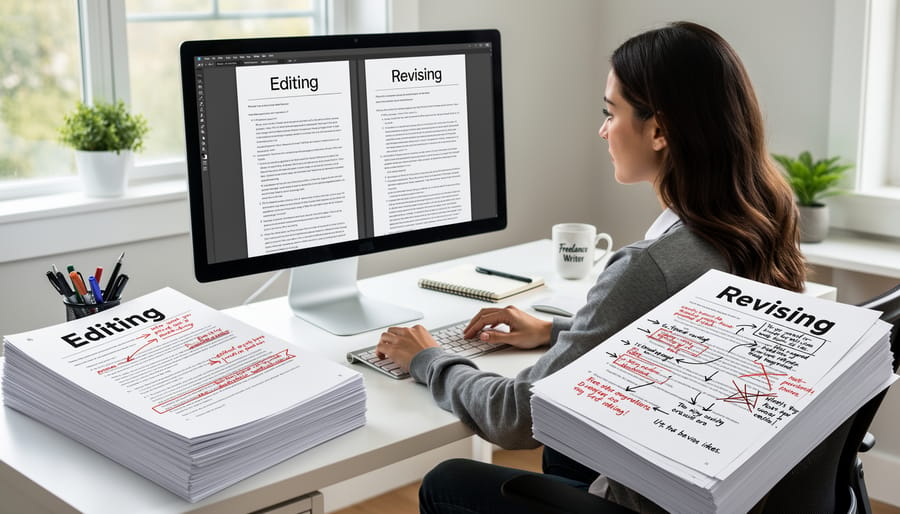
Understand the difference between editing and revising to price your freelance services accurately and build trust with clients. Revising addresses big-picture elements like structure, argument flow, and content organization—it’s about reshaping your work’s foundation. Editing focuses on sentence-level improvements: grammar, punctuation, word choice, and clarity. When you pitch clients or define your service packages, specify which you’re offering. A revision might mean restructuring three paragraphs and cutting 500 words, while editing polishes existing sentences without major content changes. This clarity prevents scope creep and ensures fair compensation for your time. Many successful Canadian freelancers offer tiered packages—basic editing at one rate, comprehensive revision and editing at another—giving clients transparent choices. Knowing this distinction also helps you evaluate job postings: if a client requests “light editing” but describes wholesale content restructuring, you’ll recognize the mismatch and negotiate appropriate terms. This knowledge protects your rates, manages client expectations, and establishes you as a professional who understands the craft’s nuances.
What Editing Actually Means in Freelance Writing
Editing is where your writing transforms from good to great. Think of it as the fine-tuning stage where you polish what you’ve already created. When you’re editing, you’re working with content that’s essentially complete—you’re not changing your core message or adding major new sections.
So what does editing actually involve? It’s all about improving the technical quality and readability of your work. You’re checking grammar, fixing punctuation errors, and ensuring every sentence flows smoothly into the next. You’re looking at word choice, cutting unnecessary phrases, and making sure your writing sounds natural and clear.
Here’s a practical example: imagine you’ve written an article about budgeting tips. During editing, you might notice you’ve used the word “important” five times in three paragraphs. You’d swap some of those out for alternatives. You’d catch a comma splice, fix a subject-verb agreement issue, and restructure an awkward sentence that made readers work too hard to understand your point.
Editing also includes technical editing, where you verify facts, check formatting consistency, and ensure your style guide compliance.
Many successful Canadian freelancers describe editing as their confidence booster. Sarah, a Toronto-based writer, shares: “Editing is when I make my first draft client-ready. It’s methodical, almost meditative work.”
The key difference? Editing assumes your content structure and ideas are solid. You’re not rethinking your approach or reorganizing major sections—that’s a different process entirely. You’re simply making what exists read better, sound clearer, and appear more professional.
What Revision Really Involves
Revision is where the real magic happens in your writing journey. Think of it as stepping back from your draft and asking the big questions: Does this actually make sense? Is my argument clear? Have I organized my thoughts in the most logical way?
When you revise, you’re working at the structural level. You might realize that your introduction buries the main point three paragraphs down, so you reorganize to hook readers immediately. Perhaps an entire section doesn’t support your thesis, so you cut it—even if it means deleting paragraphs you spent hours crafting. You might discover gaps in your logic and need to add new research or examples to strengthen your argument.
Here’s a concrete example: Imagine you’ve written a blog post about freelancing tips. During revision, you notice the piece jumps randomly between finding clients, setting rates, and managing time. You’d reorganize these into clear sections that flow logically. You might add a new section on contracts because you realize it’s a crucial gap. You could remove an anecdote that seemed funny at first but actually distracts from your main message.
Revision also involves rethinking your audience. Maybe you initially wrote for beginners but included too many advanced concepts. During revision, you’d adjust the depth and tone to better serve your readers.
This process is messy and demanding, but it’s also incredibly rewarding. Many successful Canadian freelance writers credit their willingness to revise deeply as the skill that sets their work apart. One veteran writer shared how revising a client proposal three times—completely restructuring it each time—landed her a contract worth thousands.
The key difference from editing? Revision changes what you say and how you say it at a fundamental level, while editing polishes how you’ve already said it.
The Critical Differences That Impact Your Work
Scope and Depth
Understanding the scope of each process helps you communicate clearly with clients and price your services fairly. Editing operates at the sentence level, polishing your existing words for clarity, grammar, and flow. Think of it as fine-tuning what’s already there—fixing typos, tightening sentences, and ensuring consistency. It’s the final shine on a nearly complete piece.
Revision, however, goes much deeper. You’re examining the foundation of your work: Does this argument make sense? Is this section in the right place? Should I cut this entire paragraph? Revision can mean restructuring whole sections, rewriting passages, or even reimagining your approach. It’s transformative work that shapes the very heart of your piece. Knowing this distinction empowers you to set appropriate expectations and timelines with clients, building trust and ensuring everyone’s on the same page about deliverables.
Time and Effort Required
Understanding the time investment for each process helps you set realistic deadlines and quote fairly. Revision typically demands significantly more time and creative energy than editing. When you revise, you’re reimagining content structure, strengthening arguments, and sometimes rewriting entire sections—this deep work can’t be rushed. You might spend hours reworking a single paragraph to ensure it flows naturally and serves your purpose effectively.
Editing, while detail-oriented and requiring concentration, usually moves faster since you’re polishing existing content rather than rebuilding it. Many successful freelancers allocate two to three times more hours for revision than editing when planning projects. This distinction matters when discussing timelines with clients. Being upfront about revision time protects your creative process and ensures quality work. It also helps clients understand why rushing revisions compromises results. When you accurately estimate these different time requirements, you build trust, prevent burnout, and deliver your best writing consistently.
When Each Happens in Your Writing Process
Understanding when to revise and edit helps you work more efficiently and produce better results. The golden sequence is: draft, revise, then edit. Here’s why this order matters for your success.
During your first draft, focus solely on getting ideas down without judgment. This frees your creativity and prevents perfectionism from stalling your progress. Once you’ve completed your draft, step into revision mode. This is where you reshape content, reorganize paragraphs, strengthen arguments, and ensure your message resonates with readers. Think big-picture improvements.
Only after you’re satisfied with your content’s structure and flow should you move to editing. Now you’re polishing sentences, correcting grammar, fixing typos, and ensuring consistency. Editing before revising wastes valuable time because you might delete or completely rewrite those perfectly polished sentences during revision.
Many successful freelancers follow this sequence religiously, finding it reduces stress and improves quality. When you respect each stage, you’ll deliver stronger work to clients, build your reputation, and justify fair rates for the distinct skills you’re applying at each phase.
Why This Distinction Matters for Ethical Practice
Setting Honest Client Expectations
When you clearly explain to clients whether you’re offering editing or revision services, you’re building a foundation of trust that leads to stronger working relationships. Start by creating simple service descriptions that outline exactly what’s included. For example, if you offer developmental editing, explain that you’ll focus on structure and content flow, not line-by-line grammar corrections.
Being upfront about your services prevents those awkward moments when a client expects a complete manuscript overhaul but receives proofreading instead. Many successful Canadian freelancers include comparison charts on their websites showing what each service covers and at what price point.
This transparency doesn’t just protect you from scope creep—it also helps clients budget appropriately and understand the value you’re providing. When clients know exactly what they’re getting, they’re more likely to become repeat customers and refer others to your services. Remember, confusion leads to dissatisfaction, but clarity creates confidence in your professionalism.
Pricing Your Services Fairly
Understanding the difference between revision and editing helps you price your services confidently and fairly. Revision typically requires deeper intellectual engagement with content structure, argument flow, and overall messaging. It takes more time and creative energy than editing, which focuses on surface-level corrections. Your rates should reflect this distinction.
Consider charging hourly for complex revision work since project scope can evolve, while flat rates often work well for straightforward editing tasks. Be upfront with clients about what each service includes. Clear pricing prevents misunderstandings and builds trust.
When you explain your rates, clients appreciate knowing exactly what they’re paying for. For example, you might say: “Editing focuses on grammar and polish, while revision involves restructuring and content development.” This transparency protects your time and ensures clients receive the service they actually need. Many successful freelancers find that honest communication about pricing differences leads to better client relationships and more sustainable income.
Delivering What You Promise
When you understand the difference between editing and revising, you can accurately describe your services to clients. This transparency builds trust and strengthens your professional reputation. If a client asks for editing but their manuscript needs substantial revision, be honest about what the project requires. Explain the scope of work and adjust your pricing accordingly. Including clear definitions in your contracts protects both you and your client from misunderstandings. Following ethical editing principles means never overcharging by claiming extensive revision work when simple editing will do, or undervaluing your expertise by accepting editing rates for revision-level work. Your integrity depends on delivering exactly what you promise, which starts with using the right terminology from your very first client conversation.
Red Flags: When You’re Doing More Than You’re Charging For
You know that uncomfortable feeling when a project starts spiraling beyond what you originally agreed to? That’s your internal alarm system telling you something’s off. Here are some telltale signs you’re giving away services for free.
Watch for clients who ask you to “just quickly” restructure entire paragraphs or sections during what was supposed to be a proofreading job. If you quoted for editing but find yourself rewriting weak arguments, developing new examples, or filling in content gaps, you’ve crossed into revision territory without adjusting your rate.
The phrase “while you’re at it” is a major red flag. When clients casually add “while you’re at it, could you make this section flow better?” or “maybe add some stronger points here?”, they’re requesting revision-level work. Similarly, if you’re spending hours brainstorming solutions to structural problems that weren’t part of your original scope, you’re undercharging.
Another common scenario: You deliver edited work, and the client returns it asking you to “fix” sections by adding new content or completely reworking the approach. That’s not fixing your edits—that’s requesting a new round of revisions.
Here’s the good news: recognizing these patterns empowers you to have honest conversations with clients. A simple “I’d be happy to help with that—let me send you a revised quote for these additional services” protects your time and builds respect. You’re not being difficult; you’re being professional. Canadian freelancers who set clear boundaries consistently report stronger client relationships and better income stability.

How to Communicate These Differences to Clients
Clear communication builds trust and prevents misunderstandings. When you explain the difference between editing and revising to clients upfront, you set realistic expectations and establish yourself as a professional who values transparency.
Start incorporating these distinctions into your proposals and contracts. Instead of offering a vague “editing package,” break down your services clearly. For example: “Revision focuses on restructuring content, developing ideas, and ensuring your message connects with readers. Editing refines grammar, punctuation, and sentence flow.” This clarity helps clients understand what they’re paying for and why different services carry different rates.
During initial conversations, try this approach: “I noticed your draft has strong ideas but needs organizational work. That’s revision—we’d look at structure and flow first. Once that’s solid, we can move to editing for polish.” This educates clients while demonstrating your expertise.
For proposals, use sample language like: “Phase 1 includes two rounds of revision to strengthen your argument and reorganize sections. Phase 2 covers line editing for clarity and grammar.” Breaking projects into phases makes the process less overwhelming and justifies your pricing structure.
When working on collaborative writing projects, these distinctions become even more important. Multiple contributors need to understand which feedback relates to big-picture changes versus surface-level corrections.
Remember, educating clients isn’t about complicating things—it’s about setting both of you up for success. When clients grasp what each service entails, they appreciate your work more, provide better feedback, and become repeat customers. You’ll spend less time managing confusion and more time doing the work you love. That’s a win for everyone involved.

Success Story: How One Freelancer Transformed Their Business
Meet Sarah Chen, a Toronto-based freelance writer who struggled with inconsistent income and confused clients until she discovered the power of distinguishing between editing and revising services.
For three years, Sarah quoted flat rates for “editing” without clarifying what that meant. Clients often expected multiple rounds of revisions included, leaving her underpaid and frustrated. Everything changed when she restructured her service offerings.
Sarah now clearly separates revision services (addressing big-picture content issues like structure and argument flow) from editing services (polishing grammar, style, and consistency). She created a simple pricing sheet explaining each service with real examples, and she walks new clients through the differences during initial consultations.
The results? Her income increased by 40 percent within six months. Client satisfaction scores improved because expectations were crystal clear from the start. She also reduced revision requests by nearly half since clients now understood which service they actually needed.
Sarah’s advice to fellow Canadian freelancers: “Transparency isn’t just ethical—it’s profitable. When you respect your clients enough to educate them about what they’re purchasing, they respect your expertise and value your time appropriately.”
Understanding the difference between editing and revising isn’t just about semantics—it’s about building a freelance practice rooted in transparency and trust. When you communicate these distinctions clearly to your clients, you’re setting the foundation for fair pricing, realistic timelines, and professional respect. This knowledge empowers you to advocate for your expertise while educating clients about the value you bring to their projects.
Take a moment this week to review your service descriptions and pricing structures. Are you clearly distinguishing between revision work and editing services? Are your rates reflecting the different skill levels and time commitments involved? Making these adjustments might feel uncomfortable at first, but remember that clarity benefits everyone—clients know exactly what they’re purchasing, and you can deliver services with confidence.
Your growth as a freelance writer isn’t just measured in bylines or income. It’s also reflected in how you establish boundaries, communicate your value, and build sustainable working relationships. By mastering these fundamental distinctions and applying them ethically, you’re not just improving your business practices—you’re contributing to a more professional, respected freelance writing industry across Canada.