

Build a research system that captures every valuable source in under 30 seconds by creating a simple three-folder structure: “Active Projects,” “Reference Library,” and “Future Ideas.” Use free tools like Google Keep or Notion to tag sources by topic, client, and urgency, ensuring you’ll never waste time hunting for that perfect quote again.
Set up search alerts through Google Scholar and industry publications to deliver relevant content directly to your inbox each morning. Spend 15 minutes daily reviewing these automated feeds while having coffee, marking promising articles for deeper reading later. This passive research approach keeps your knowledge current without eating into billable hours.
Develop a standardized fact-checking protocol that includes verifying information through at least two credible sources, bookmarking original studies rather than secondary reports, and maintaining a spreadsheet of go-to expert contacts for quick verification. Canadian freelance writer Sarah Chen increased her research speed by 40% using this exact method, landing her three new magazine contracts within six months.
Create reusable research templates for common article types you write. A health article template might include sections for peer-reviewed studies, expert quotes, statistics, and patient stories. Templates transform overwhelming research tasks into manageable checklists, helping you move from idea to draft faster while maintaining quality.
Master these practical systems and you’ll transform research from a time-consuming obstacle into your competitive advantage. The writers who thrive in today’s freelance market aren’t necessarily the fastest typers—they’re the ones who’ve built smart, sustainable workflows that make every research minute count.
Why Research Makes or Breaks Your Freelance Writing Career
Quality research isn’t just a nice-to-have skill for freelance writers—it’s the foundation that separates thriving professionals from those struggling to find their next gig. When you consistently deliver well-researched content, you build credibility that opens doors to higher-paying opportunities and long-term client relationships.
Think about it from a client’s perspective. They’re trusting you to represent their brand, educate their audience, or inform their customers. When your work is backed by solid research, you demonstrate reliability and professionalism. Clients notice when facts are accurate, sources are credible, and insights go beyond surface-level information. This attention to detail directly translates into client satisfaction and those coveted repeat contracts that form the backbone of building a sustainable freelance career.
Strong research skills also justify premium rates. Writers who can dig deeper, find unique angles, and present thoroughly vetted information naturally command higher fees. You’re not just delivering words—you’re delivering expertise and peace of mind.
Consider Sarah, a Toronto-based freelance writer who spent her first year accepting any project at low rates. Her research process was rushed, often relying on the first few Google results. Client feedback was lukewarm, and she rarely heard back for additional work. Everything changed when she invested time in developing a systematic research approach. She started using proper fact-checking protocols, diverse source verification, and organized note-taking systems. Within six months, her rates doubled. Clients began specifically requesting her for complex projects requiring detailed research. One healthcare client even told her, “We trust your research more than our junior staff writers.”
The lesson? Your research quality directly impacts every aspect of your freelance success. Better research means better content, happier clients, stronger testimonials, and ultimately, a more profitable and fulfilling writing career. It’s an investment that pays dividends with every project you complete.

The Three Pillars of Freelance Research
Finding Reliable Sources Fast
Finding trustworthy information quickly is one of the most valuable skills you can develop as a freelance writer. The good news? You don’t need expensive subscriptions to access quality sources.
Start with Google Scholar for academic papers and studies. It’s completely free and filters out much of the noise you’ll find in regular search results. For Canadian-specific content, add “site:.ca” to your searches to prioritize domestic sources. Government websites ending in .gc.ca are goldmines for statistics, reports, and verified data.
Master a few simple Google search operators to save hours of scrolling. Use quotation marks around phrases for exact matches, minus signs to exclude terms, and “filetype:pdf” to find research reports and white papers. These small tricks can cut your research time in half.
Public libraries across Canada offer free access to premium databases through your library card. Services like PressReader, JSTOR, and ProQuest become available at no cost, giving you the same resources professional researchers use.
Watch for red flags that signal unreliable sources: missing author credentials, no publication date, excessive ads, inflammatory language, or claims without citations. If a website looks designed in 1995 or makes you feel like you need a shower afterward, trust that instinct.
Build a personal library of trusted sources in your niche. When you find a reliable journal, think tank, or expert blog, bookmark it. Over time, you’ll develop go-to resources that consistently deliver credible information, making future research projects even faster.
Organizing Your Research So You Can Actually Find It Later
The best research system is the one you’ll actually use consistently. Start simple with a folder structure on your computer that mirrors your writing categories—maybe “Health Articles,” “Tech Clients,” and “Personal Essays.” Within each folder, create subfolders by project or topic. This straightforward approach costs nothing and works beautifully for writers just starting out.
For digital bookmarks and web clippings, free tools like Google Keep or Notion offer excellent starting points. Google Keep works particularly well for quick saves and voice notes during phone interviews, while Notion provides more robust organization with databases and tags. Many Canadian writers swear by Evernote’s free tier for its powerful search function that can even find text within images and PDFs.
If you’re ready to invest in your research workflow, consider tools like Zotero (free but powerful for academic-style research), Airtable (around $10 monthly), or Roam Research. Toronto-based writer Sarah Chen credits her switch to Airtable with cutting her research retrieval time in half: “I tag everything by client, topic, and article status. Finding that perfect quote from three months ago now takes seconds, not twenty minutes of frantic scrolling.”
Whatever system you choose, make tagging a habit from day one. Use consistent labels like “interview notes,” “statistics,” or “expert quotes.” Add brief context notes about why you saved something—future you will be grateful. Remember, you’re building a personal knowledge library that grows more valuable with every project you complete.
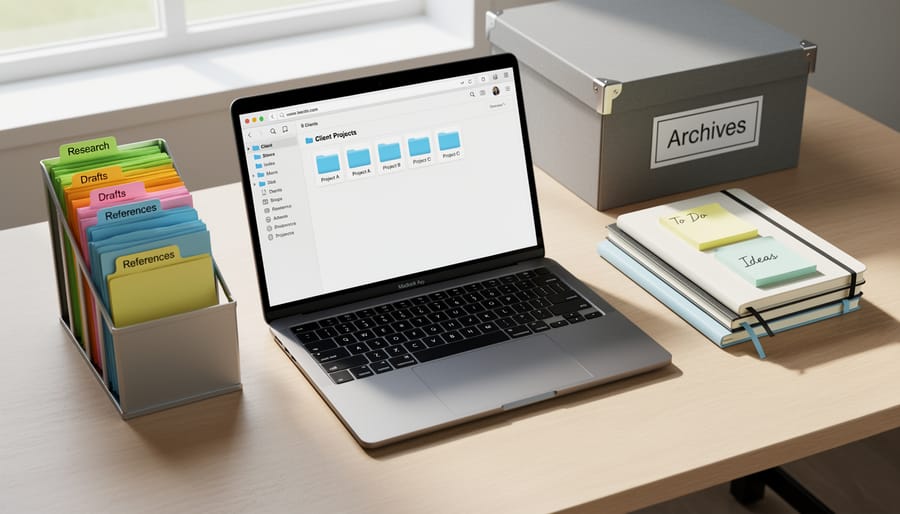
Building Your Personal Knowledge Bank
Think of your personal knowledge bank as your secret weapon—a curated collection of research that works for you long after a project wraps up. Every article you research, every expert you interview, and every credible source you discover becomes a valuable asset you can draw from again and again.
Start by organizing your research in a way that makes sense for your niche. Create a simple folder system on your computer or use free tools like Google Drive or Notion. Vancouver-based freelancer Sarah Chen shares her approach: “I organize my research by topic rather than by client. When I write about healthcare innovation, I can pull from the same knowledge bank whether I’m writing for a magazine or a corporate blog.”
Save key information like expert quotes, statistics, case studies, and reliable source contacts. Include URLs, publication dates, and brief notes about why each resource matters. This habit transforms random research into a searchable library.
The real magic happens when you revisit these materials for future projects. You’ll spend less time starting from scratch and more time adding depth to your work. Plus, this growing expertise makes you more confident pitching editors and commanding higher rates.
Consider creating templates for common research tasks in your specialty. If you frequently research Canadian industry trends, develop a checklist of go-to sources and key questions. These small investments in organization pay dividends throughout your freelance career, positioning you as the knowledgeable professional clients return to time and again.
Time-Saving Research Strategies for Busy Freelancers
The 80/20 Rule for Research Efficiency
Not all research carries equal weight. The Pareto Principle suggests that 20% of your research efforts typically generate 80% of your article’s value. Your job is to identify that crucial 20% before diving deep into rabbit holes.
Start by asking what your reader absolutely needs to know. For a piece on mortgage rates, detailed Bank of Canada statistics matter more than general economic theory. For a profile on a Toronto entrepreneur, direct quotes and personal anecdotes trump generic business advice. Focus your energy on primary sources, expert interviews, and data that directly supports your main points.
Smart freelancers connect research efficiency with broader time management strategies. Set a timer for initial research sessions—perhaps 30 minutes to identify key sources and another hour for deep dives. If you’re three hours in and still collecting background information, you’ve likely moved past that valuable 20%.
Consider what makes your angle unique. If everyone covers the same Statistics Canada report, your 20% might be finding a local expert who can contextualize those numbers for your specific audience. That single interview could provide more article value than a dozen generic sources.

Interview Shortcuts That Build Authority
Expert interviews don’t have to be time-consuming to add serious credibility to your work. Start by identifying sources who can speak directly to your topic, then reach out with specific, focused questions via email. This approach respects their time and gives you quotable responses without scheduling lengthy phone calls.
When you do conduct interviews, prepare three to five targeted questions that get to the heart of your article. Record the conversation (with permission) so you can focus on listening rather than frantically taking notes. You’ll capture authentic quotes that bring authority to your piece while keeping the actual interview under 15 minutes.
Here’s a time-saving tip from successful freelancers: build relationships with experts in your niche areas. When you’ve interviewed someone once and delivered quality work, they’re often happy to provide quick quotes for future articles. Keep a simple spreadsheet of your expert contacts, their areas of expertise, and preferred contact methods.
Social media can also be your friend here. Many professionals share insights on LinkedIn or Twitter that you can reference (with proper attribution). A well-placed expert quote transforms a good article into a trusted resource, and clients notice the difference. This investment in credibility often leads to higher-paying assignments and repeat work.
Repurposing Research Across Multiple Projects
One of the smartest strategies for maximizing your research efforts is learning to repurpose what you’ve already gathered across different projects. This approach saves time and increases your earning potential, but it requires a thoughtful, ethical approach.
Start by creating a personal knowledge base organized by topic rather than by client. When you research sustainable agriculture for one article, those statistics, expert insights, and background information can inform future pieces on environmental topics, food security, or rural economies. The key is understanding the difference between repurposing research and recycling content. Your research findings are building blocks; how you use them must be original for each client.
Always respect client confidentiality and intellectual property. Any proprietary information, unpublished data, or unique angles developed specifically for one client stays with that client. However, publicly available statistics, general industry knowledge, and your growing expertise in a subject area are yours to leverage.
Consider specializing in two or three subject areas where your research compounds over time. Toronto-based freelancer Maria Chen focuses on healthcare and technology topics. She maintains a digital filing system where general research lives in topic folders, separate from client-specific projects. This system has cut her research time in half while deepening her expertise, allowing her to command higher rates.
The beauty of this approach is that each project strengthens your knowledge foundation, making you faster and more valuable with every assignment you complete.
Free and Affordable Research Tools Canadian Writers Should Know About
Building a solid research toolkit doesn’t have to break the bank. Here are practical, budget-friendly resources that Canadian freelance writers can access right away.
Google Scholar remains your best friend for academic research and credible sources. It’s completely free and indexes peer-reviewed papers, theses, and scholarly articles across disciplines. Use it when you need authoritative sources to back up your claims or dive deep into specialized topics.
Your local library card unlocks incredible digital resources. Most Canadian public libraries provide free access to databases like JSTOR, EBSCOhost, and Canadian Newsstand through their websites. Toronto, Vancouver, and Montreal libraries offer particularly robust collections. This access alone can save you hundreds of dollars annually.
Zotero stands out as a free research management tool that helps you organize sources, generate citations, and keep notes in one place. It’s perfect for longer projects where tracking multiple sources becomes challenging. Many successful Canadian writers credit Zotero with transforming their workflow from chaotic to streamlined.
For quick fact-checking, Statistics Canada provides free, reliable data about demographics, economics, and social trends. It’s invaluable when writing about Canadian topics and adds credibility to your work.
Evernote’s free version works well for capturing research snippets, web clippings, and interview notes. While premium features exist, the basic plan handles most freelance needs effectively.
Trello offers free project boards that help visualize your research process. Create columns for sources to review, verified information, and content ready to write. It’s especially helpful when juggling multiple client projects.
These tools integrate beautifully with other essential writing tools in your arsenal. Start with one or two that address your biggest pain points, then expand as your research needs grow. The key is consistency rather than complexity.
Common Research Mistakes (And How to Avoid Them)
Even experienced freelance writers stumble into research traps that waste time and compromise quality. Recognizing these pitfalls early helps you work smarter and deliver better results to your clients.
Over-researching ranks among the most common freelance writing mistakes. You fall down rabbit holes, collecting far more information than you’ll ever use. Set clear research boundaries before you start. Define exactly what questions you need answered, then stop when you have sufficient information. Remember, you’re writing an article, not a doctoral thesis.
Relying on outdated information damages your credibility and misleads readers. Always check publication dates, especially for topics like technology, health, or Canadian regulations that change frequently. Make it a habit to verify that sources are current and cross-reference facts with recent publications. A good rule of thumb: prioritize sources from the past three years unless you’re covering historical topics.
Poor fact-checking creates embarrassing errors that clients and editors will catch. Develop a verification system where you confirm every statistic, quote, and claim with at least two reputable sources. Keep detailed notes about where each fact originated so you can quickly double-check if questions arise.
Citation errors frustrate editors and waste revision time. Create a citation template that matches your client’s preferred style guide, whether that’s APA, MLA, or Chicago. Record source details immediately when you find useful information, not later when you’re writing. This simple habit saves hours of backtracking to locate original sources.
By addressing these common mistakes proactively, you’ll build a reputation for accuracy and efficiency that keeps clients coming back.
Building Research into Your Freelance Writing Workflow
Research doesn’t have to be a separate, time-consuming phase that throws off your entire schedule. The key is making it a natural part of your writing process rather than treating it as an extra task.
Start by building research time into your project quotes from the beginning. A good rule of thumb is to estimate that research will take about 25-30% of your total project time for informational articles. For complex topics or those requiring expert interviews, bump that to 40%. Be upfront with clients about this. You might say, “This article will require approximately three hours of research and five hours of writing.” Most clients appreciate the transparency and understand that quality content needs a solid foundation.
When communicating research needs to clients, ask specific questions early. Do they have preferred sources? Are there any experts they’d like you to interview? What depth of research do they expect? These conversations prevent scope creep and ensure you’re both on the same page about deliverables.
Create a simple research template you can reuse for every project. Include sections for key facts, statistics, expert quotes, and source links. This consistency helps you streamline your workflow and makes it easier to reference information later.
Consider batching your research tasks. Spend one focused block gathering all your sources, then another block reading and note-taking. This approach is more efficient than constantly switching between research and writing modes.
Toronto-based freelancer Maya Chen shares her success: “Once I started billing separately for research time and explaining its value to clients, my income increased by 20%. Clients respected the professionalism, and I felt fairly compensated for the work involved.”
You’ve now got a comprehensive toolkit for transforming how you approach freelance research. By mastering these strategies, you’re not just improving your workflow—you’re building a genuine competitive advantage that sets you apart in the Canadian freelance writing market. When you can deliver well-researched, accurate content faster than your competitors, clients notice. They come back. They refer you to others. And most importantly, they’re willing to pay premium rates for that reliability.
The financial impact of efficient research is real. Writers who develop strong research systems typically reduce project turnaround time by 30-40%, allowing them to take on more assignments without sacrificing quality. Less time spinning your wheels means more billable hours and higher monthly income. Plus, there’s the stress reduction factor—when you have a trusted system for finding, evaluating, and organizing information, those moments of panic about finding credible sources disappear.
Here’s your next step: don’t try to implement everything at once. Choose one strategy from this article that resonates most with your current challenges. Maybe it’s setting up a simple citation management system, or perhaps it’s creating a research template for your most common project types. Commit to testing that one approach on your very next assignment. Small, consistent improvements compound over time, and before you know it, you’ll have transformed research from a dreaded task into one of your strongest professional skills. Your future self—and your bank account—will thank you.