

Master the six writing traits—ideas, organization, voice, word choice, sentence fluency, and conventions—to transform your freelance writing from adequate to exceptional. This proven framework gives you a concrete roadmap to improve your craft and deliver work that makes clients eager to hire you again.
Strong ideas mean you’ll spend less time staring at blank screens and more time producing content that resonates. Clear organization ensures your articles flow logically, reducing revision requests and saving you billable hours. Developing your unique voice helps you stand out in a crowded marketplace where thousands of writers compete for the same opportunities.
Word choice precision prevents miscommunication and builds your reputation for quality. Sentence fluency keeps readers engaged from headline to conclusion, increasing the likelihood your work gets shared and noticed. Solid conventions show professionalism that reassures clients they’ve made the right choice.
When you consistently apply these six traits, you’ll notice editors requesting fewer revisions, clients referring you to their networks, and your confidence soaring with each completed project. Whether you’re landing your first client or managing a full roster, this framework provides the foundation for sustainable freelance success. Each trait builds on the others, creating a comprehensive approach that elevates every piece you write—from blog posts and web copy to articles and marketing materials.
What Are the 6 Writing Traits?
The 6+1 Trait Writing Model might sound like something from your high school English class, but it’s actually one of the most practical frameworks you can use to elevate your freelance writing career. Education Northwest developed the 6+1 Trait Model in the 1980s as a way to teach and assess writing quality, and it’s since become a cornerstone in writing instruction across North America. While it was originally designed for educators and students, freelance writers have discovered that these same principles provide an excellent roadmap for self-editing and professional growth.
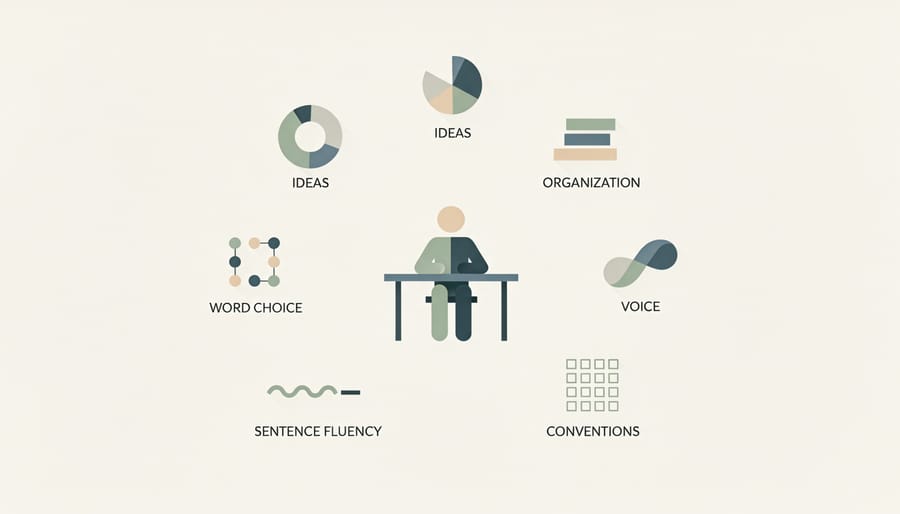
The model breaks down effective writing into seven distinct characteristics: Ideas, Organization, Voice, Word Choice, Sentence Fluency, Conventions, and Presentation (the “+1” trait). Each trait represents a specific aspect of writing quality that you can identify, evaluate, and improve independently. Think of them as different lenses through which to examine your work, helping you spot weaknesses you might otherwise miss.
For Canadian freelance writers working across diverse projects—from blog posts to marketing copy to technical documentation—understanding these traits gives you a universal language for quality. Instead of vaguely knowing something feels off about your draft, you can pinpoint whether it’s a word choice issue, an organizational problem, or a voice mismatch. This targeted approach to self-editing not only improves your craft but also saves you time and frustration. You’ll find yourself producing client-ready work more quickly and confidently, which translates directly into increased productivity and earnings.
Trait 1: Ideas—The Heart of Your Content
Think of ideas as the spark that ignites everything you write. Without a strong, focused idea at its core, even the most beautifully crafted piece falls flat. For freelance writers, this trait separates memorable content from forgettable filler—and clients absolutely notice the difference.
Strong ideas aren’t just about picking a topic. They’re about finding the angle that makes readers lean in closer. When you’re assigned to write about something seemingly ordinary—like home organization or email marketing—your job is to discover what makes it interesting. What question keeps your target audience awake at night? What perspective haven’t they considered?
Here’s a practical approach: Start with broad brainstorming, then narrow ruthlessly. Let’s say you’re writing about remote work. That’s broad. But “three unconventional ways Canadian freelancers can claim home office expenses” is focused, specific, and speaks directly to your reader’s needs.
One successful Toronto-based freelancer shared that her breakthrough came when she stopped trying to cover everything and started drilling down into one compelling angle per piece. Her client retention doubled because her articles delivered clear value instead of surface-level overviews.
To strengthen your ideas, ask yourself: What’s the one thing I want readers to remember? If they forget everything else, what single insight should stick? This clarity transforms your writing from informative to impactful.
Creativity plays a huge role here. Even well-worn topics have fresh angles waiting to be discovered. Read widely outside your niche, observe everyday conversations, and pay attention to questions people actually ask. Sometimes the best ideas come from connecting dots others haven’t noticed.
Remember, strong ideas aren’t always revolutionary—they’re relevant, focused, and genuinely useful to your reader. Master this foundation, and you’ll find clients returning to you again and again, because you consistently deliver content that resonates rather than just fills space.

Trait 2: Organization—Creating Reader-Friendly Flow
Think of organization as the roadmap that guides your readers from introduction to conclusion without confusion or frustration. When your writing follows a logical structure with smooth transitions, readers stay engaged and absorb your message effortlessly. Research shows that text organization affects comprehension, which directly impacts whether your clients achieve their content goals.
For freelance writers, strong organization isn’t just about clarity—it’s a professional signature that sets you apart. Well-structured articles require fewer revisions, saving you time and building client trust. When your pieces flow naturally from one point to the next, clients recognize your expertise and return for future projects.
Start every project with an outline, even for shorter pieces. Identify your main points and arrange them in a sequence that makes sense for your specific content type. Blog posts often work best with the problem-solution-benefit structure, while how-to articles need step-by-step progression. Case studies typically follow a challenge-action-results format.
Transitions are the glue holding your organized thoughts together. Simple phrases like “building on this idea” or “another key consideration” help readers move smoothly between sections. Review your draft specifically for transition quality—if jumping between paragraphs feels jarring, you need better connective tissue.
Here’s a success story: Montreal freelancer Sarah improved her client retention by 40% simply by implementing detailed outlines before writing. Her clients noticed the difference immediately, praising how her organized content required minimal edits and communicated complex ideas clearly. She now commands premium rates because her organizational skills save clients valuable time.
Trait 3: Voice—Your Unique Writing Fingerprint
Voice is what makes your writing uniquely yours—it’s the personality that shines through your words and sets you apart from every other freelance writer. While grammar and organization matter, voice is what makes clients say, “Yes, this writer gets it.”
Think of voice as your writing fingerprint. It encompasses your word choices, sentence rhythm, humor level, and overall attitude. For freelance writers, developing your authentic voice is essential, but so is learning when to adapt it.
Your authentic voice is your default style—the way you naturally express ideas. Maybe you’re witty and conversational, or perhaps you lean toward thoughtful and contemplative. This core voice becomes your brand and helps clients remember you. Toronto-based freelancer Sarah M. found that her warm, encouraging voice landed her consistent work with wellness brands seeking approachable content. “My voice became my calling card,” she shares.
However, successful freelancers also know when to dial their voice up or down. A tech company blog might require a more polished, professional tone, while a lifestyle magazine could welcome your playful side. The key is adapting without losing yourself entirely. You’re not creating a completely different voice—you’re adjusting the volume.
Here’s how to balance personality with professionalism: Start by studying your target publication. Read several articles to understand their typical tone. Are they formal or casual? Do they use humor? Then, match that general feel while keeping your unique perspective intact.
Consider your audience too. Writing for senior executives demands different language than content aimed at college students. Adjust your vocabulary, sentence length, and examples accordingly, but maintain your underlying approach to storytelling and explanation.
The beauty of voice is that it’s always evolving. Each project teaches you something new about flexibility and expression. Embrace this growth while staying true to what makes your writing distinctively yours. That authentic foundation, combined with professional adaptability, creates the winning combination that keeps clients coming back.
Trait 4: Word Choice—Precision That Powers Impact
The words you choose define your professional voice and separate memorable writing from forgettable content. When you select precise, vivid language, you show clients you’re worth every dollar they invest in your services.
Think of word choice as your credibility toolkit. Instead of writing “The company did well last quarter,” try “The company’s revenue jumped 23% last quarter.” See the difference? Specific language demonstrates you’ve done your research and understand the subject matter deeply.
Strong word choice doesn’t mean drowning readers in obscure vocabulary or industry jargon. It means choosing the exact right word for each situation. Consider your audience: if you’re writing for homeowners about roof repairs, “shingles deteriorating” works better than “roofing substrate experiencing degradation.” Accessible language builds trust.
Canadian freelancer Maria Thompson transformed her business by refining her word choices. “I used to write ‘very good’ and ‘really important’ constantly,” she shares. “When I started using words like ‘exceptional,’ ‘pivotal,’ and ‘transformative’ where appropriate, clients noticed. My rates increased because my writing sounded more authoritative.”
Watch for tired phrases that weaken your impact. Replace “at the end of the day” with “ultimately.” Swap “think outside the box” for “explore creative solutions.” Fresh language keeps readers engaged and positions you as someone who brings original thinking to every project.
Here’s your practical approach: after drafting, scan for vague words like “things,” “very,” “really,” and “stuff.” Replace them with specific alternatives. If you’ve written “The results were good,” ask yourself: Were they impressive? Remarkable? Promising? The precise word reveals your expertise.
Strong word choice also means knowing when simple wins. “Use” beats “utilize” every time. “Help” trumps “facilitate.” Clear communication demonstrates confidence, not vocabulary acrobatics.
Master this trait, and you’ll spend less time on revisions because clients immediately recognize quality work.
Trait 5: Sentence Fluency—The Rhythm Readers Feel
Sentence fluency transforms good writing into something readers can’t put down. It’s the musical quality of your words—the rhythm that carries readers smoothly from one idea to the next without stumbling or losing interest.
Think of sentence fluency as the heartbeat of your writing. When you vary sentence length and structure, you create a natural cadence that keeps readers engaged. Short sentences pack punch. They create emphasis and urgency. Longer sentences allow you to explore complex ideas, connect related thoughts, and provide detailed explanations that help readers understand nuanced concepts. The magic happens when you mix them together.
For freelance writers, sentence fluency directly impacts how clients perceive your professionalism. Choppy, monotonous sentences tire readers quickly. Overly complex structures confuse them. But when your sentences flow naturally, clients notice. They see someone who understands how language works and how to keep their audience reading.
Start by paying attention to how your sentences begin. If five consecutive sentences start with “The” or “I,” you’ve found an opportunity for improvement. Experiment with different openings: questions, prepositional phrases, or dependent clauses. Mix simple sentences with compound and complex structures.
Canadian freelancer Maria improved her client retention by 40% after focusing on sentence fluency. She discovered that varying her sentence patterns made her blog posts more enjoyable to read, leading to longer client relationships and regular referrals. Her secret? She treated each paragraph like a mini-composition, consciously creating rhythm through sentence variety.
When your sentences flow effortlessly, readers stay engaged, comprehension improves, and your writing stands out in a competitive marketplace.
Trait 6: Conventions—The Professional Polish
Think of conventions as the professional polish that makes your writing shine. Grammar, spelling, and punctuation might not be the most exciting aspects of writing, but they’re absolutely essential for building credibility with clients. When your work arrives clean and error-free, you’re sending a powerful message: you’re detail-oriented, reliable, and worth every penny.
Here’s the reality—clients notice mistakes. A misplaced comma or consistent spelling errors can undermine even the most brilliant ideas. Strong command of conventions saves everyone time during the editing process, which means faster turnarounds and happier clients. When you’ve developed a solid self-editing framework that catches errors before submission, you’ll stand out from writers who rely heavily on client feedback for basic corrections.
For Canadian freelance writers, there’s an added layer to master: knowing when to use Canadian versus American spelling. Words like “colour” versus “color” or “centre” versus “center” matter depending on your client’s location and audience. Always clarify spelling preferences upfront—it’s a simple question that prevents revision headaches later.
Watch for common pitfalls like mixing up “its” and “it’s,” confusing “affect” and “effect,” or letting autocorrect make embarrassing changes. These small errors chip away at your professional image across different freelance writing projects.
The good news? Conventions are learnable skills. Invest time in grammar resources, use editing tools wisely, and read your work aloud to catch awkward phrasing. Every error you prevent is another reason for clients to choose you again. Your attention to these details demonstrates respect for your craft and your clients—and that’s what builds lasting freelance success.
Putting All 6 Traits Together: A Practical Approach
Now that you understand each trait, let’s explore how to transform good writing into exceptional work using all six traits as your self-editing framework. This systematic approach helps you catch issues before your client does, reducing revision requests and building your reputation as a polished professional.
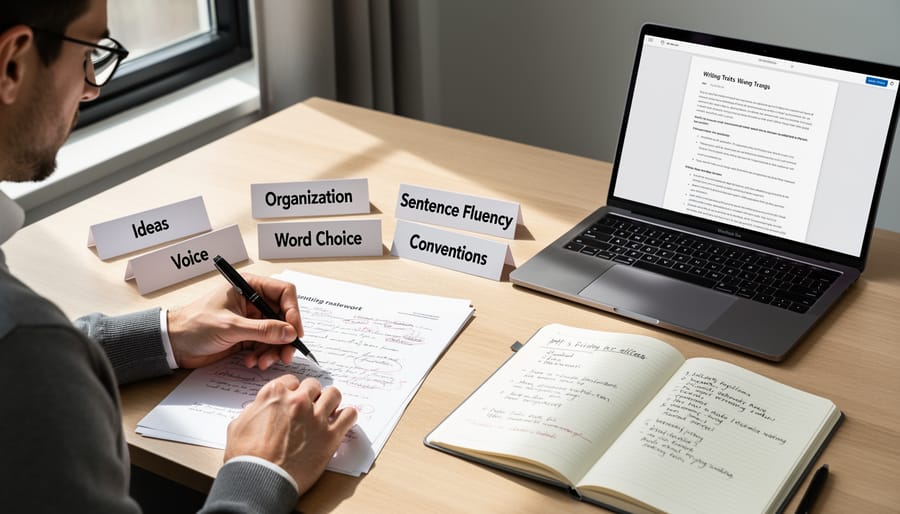
Start by completing your first draft without overthinking. Once you’ve got words on the page, set it aside for at least an hour (or overnight for important projects). Then, review your work using this step-by-step process:
- Ideas: Read through once and ask yourself if your main message is clear. Does every paragraph support your central purpose? Cut anything that doesn’t belong.
- Organization: Check your structure. Does your opening hook readers? Do your transitions flow naturally? Does your conclusion deliver?
- Voice: Read a few paragraphs aloud. Does it sound like you, or like a robot? Adjust any stiff or overly formal language to match your intended tone.
- Word Choice: Scan for vague words like “very,” “really,” or “things.” Replace weak verbs and generic descriptors with specific, vivid alternatives.
- Sentence Fluency: Read the entire piece aloud slowly. Mark any sentences that make you stumble, then rewrite them for better rhythm.
- Conventions: Finally, check spelling, grammar, and punctuation. Use tools like Grammarly as a safety net, but trust your own careful reading too.
The beauty of this framework is its flexibility across different projects. For blog posts, you might emphasize voice and organization to keep readers engaged. When writing web copy, word choice and sentence fluency become critical for scanability. Press releases demand flawless conventions and tight organization.
Toronto-based freelancer Maria uses this checklist for every assignment and reports that her client revision requests dropped by 70% within three months. That’s time saved and confidence gained—two things every freelancer values.
Mastering the 6 writing traits isn’t about being born with a special gift. It’s about understanding that great writing comes from deliberately applying ideas, organization, voice, word choice, sentence fluency, and conventions. The exciting truth? These are learnable skills that improve every time you put them into practice.
Think of these traits as your professional toolkit. Each project you complete gives you another opportunity to sharpen these skills. Sarah, a Toronto-based freelance writer, started tracking which trait she focused on with each assignment. Within three months, she noticed her clients requesting fewer revisions and her confidence soaring. “I stopped feeling like I was guessing and started writing with intention,” she shared.
Here’s your challenge: pick just one trait to focus on this week. Maybe it’s organizing your content more clearly or injecting more authentic voice into your work. Track the results. Notice how your clients respond. Pay attention to how you feel about the work you’re submitting.
The beauty of this approach is that improvement compounds. As you strengthen one trait, the others naturally benefit. Your word choice improves your voice. Better organization enhances sentence fluency. Before long, these traits become second nature, woven seamlessly into everything you write.
Start small, stay consistent, and watch your writing transform. Your future clients and your bank account will thank you for the investment in your craft.