

Assess your home workspace ergonomics by checking that your monitor sits at eye level, your chair supports your lower back, and your keyboard allows your elbows to rest at 90 degrees—poor setup causes repetitive strain injuries that 43% of Canadian remote workers report within their first year. Install proper lighting to reduce eye strain, keep electrical cords secured to prevent tripping hazards, and ensure your workspace has adequate ventilation, especially if you’re using printers or other equipment that emits fumes.
Create a mental health routine that includes regular breaks every 50 minutes, scheduled end times to prevent burnout, and dedicated non-work zones in your home, since Canadian freelancers working from home experience isolation-related anxiety at twice the rate of traditional office workers. Document any work-related injuries or health issues immediately, as you may qualify for benefits even as a self-employed individual under certain provincial programs.
Review your insurance coverage specifically for home-based business liability and consider disability insurance that replaces income if injury prevents you from writing—68% of freelancers lack adequate protection despite facing identical physical risks to employed workers. Register with your provincial workers’ compensation board if you meet self-employment criteria, as several provinces now offer voluntary coverage that protects your income during recovery from work-related injuries.
Implement a simple safety checklist covering fire extinguisher placement, first aid kit accessibility, and emergency contact information posted visibly, transforming compliance from an overwhelming obligation into manageable daily habits that protect both your health and your freelance career.
The Surprising Health Risks Freelance Writers Actually Face
You might think freelance writing is one of the safest careers out there—after all, you’re just sitting at a desk, right? The reality is quite different. Freelance writers face a unique combination of health risks that many don’t realize until they’re already experiencing symptoms.
The physical challenges start with your workspace setup. Without an employer providing ergonomic furniture, many writers work hunched over laptops on couches or at kitchen tables. This leads to chronic neck pain, shoulder tension, and back problems. Repetitive strain injuries like carpal tunnel syndrome are surprisingly common among writers who type for hours without proper wrist support or regular breaks.
Your eyes take a beating too. Staring at screens for eight to twelve hours daily causes digital eye strain, leading to headaches, blurred vision, and difficulty focusing. The blue light from your devices can also disrupt your sleep patterns, creating a cycle of fatigue that affects both your health and productivity.
The sedentary nature of writing work poses serious long-term risks. Sitting for extended periods increases your risk of cardiovascular disease, type 2 diabetes, and weight gain. Many freelance writers report feeling physically drained despite not doing physically demanding work—this is your body responding to prolonged inactivity.
Mental health challenges deserve equal attention. Working alone from home can feel isolating, especially when friends and family don’t understand that you’re actually working. The lack of social interaction can contribute to anxiety and depression. Financial stress compounds these issues—irregular income and the constant hustle to find new clients create ongoing worry that’s hard to shake.
Here’s the encouraging news: recognizing these risks is your first step toward protecting yourself. Simple changes to your workspace, establishing healthy routines, and connecting with other freelance writers can make a tremendous difference. You deserve to build a sustainable writing career that doesn’t come at the cost of your wellbeing.
What Canadian Work Safety Laws Mean for Your Freelance Business
Your Legal Responsibilities as a Self-Employed Writer
As a Canadian freelance writer, understanding your legal responsibilities around workplace safety helps protect both your wellbeing and your business. The good news? While you’re not covered by traditional employer-employee safety regulations due to your self-employed status, you have more control over creating a safe work environment.
When working from your home office, you’re responsible for maintaining safe conditions. This means ensuring your workspace has proper ergonomics, adequate lighting, and clear pathways to prevent trips and falls. While no government inspector will visit your home, taking these precautions protects you from injuries that could disrupt your income.
If you visit client locations for meetings or on-site work, different rules apply. Clients must provide you with a safe environment and inform you of any hazards. Don’t hesitate to ask about safety protocols or request protective equipment if needed. You have the right to refuse unsafe work, just as employees do.
Consider carrying liability insurance to protect yourself if accidents occur during client visits. Many professional associations offer affordable coverage designed specifically for freelance writers. Taking these steps demonstrates professionalism while safeguarding your career and health.
When Client Safety Policies Apply to You
As a freelance writer, you’ll sometimes step into situations where your client’s safety policies become your responsibility too. Understanding when this happens protects both you and your working relationships.
If you’re working on-site at a client’s office, manufacturing facility, or any physical workplace, their safety rules apply to you just like any employee. This means following evacuation procedures, wearing required protective equipment, and adhering to their workplace protocols. Some freelancers conducting interviews at industrial sites or research facilities may need steel-toed boots or hard hats, depending on the environment.
Industry-specific requirements also come into play. For instance, if you’re writing content for healthcare organizations and need to visit medical facilities, you might need vaccinations or safety training. Similarly, writing technical documentation for construction or energy sectors could require site-specific safety orientations before you can gather information firsthand.
The good news is that clients typically provide clear guidance about their safety expectations upfront. When you’re bidding on projects requiring on-site work, ask about safety requirements during your initial discussions. This shows professionalism and helps you prepare properly.
Remember, following client safety policies isn’t just about compliance—it demonstrates your commitment to professional standards and builds trust in your working relationships.
Creating Your Home Office Safety Plan (Without the Corporate Nonsense)
Ergonomics That Won’t Break Your Freelance Budget
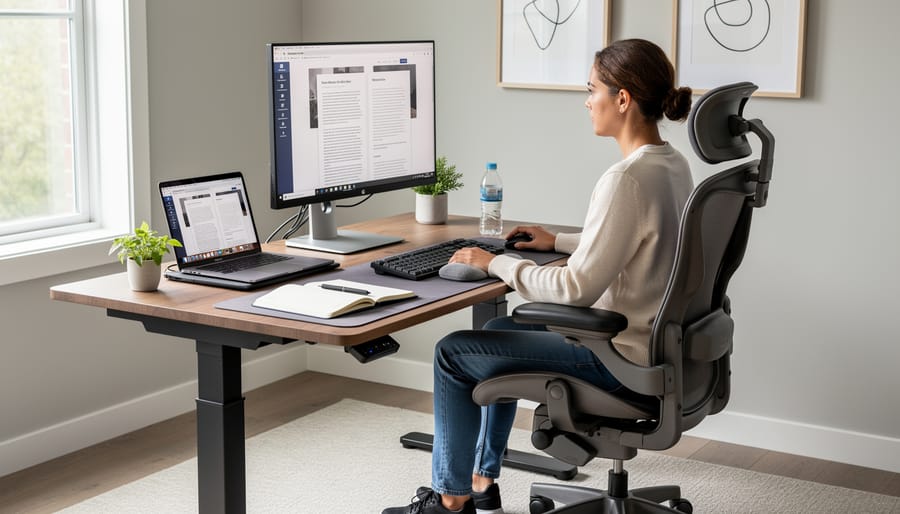
Creating an ergonomic workspace doesn’t require designer furniture or a massive investment. Start with your chair, the foundation of your setup. You don’t need a $1,000 office chair. Look for adjustable models with lumbar support at big-box stores or second-hand shops. Even a rolled towel behind your lower back can provide crucial support until you find the right chair.
Your monitor should sit at arm’s length, with the top of the screen at or slightly below eye level. Stack books under your laptop or invest in a $20 laptop stand to avoid hunching. Your neck and shoulders will thank you after those long editing sessions.
Keyboard placement matters more than you might think. Keep it close enough that your elbows rest comfortably at 90 degrees. A basic external keyboard costs around $15 and prevents the awkward reaching that comes with laptop typing. Your wrists should float naturally, not bent upward or pressed against sharp desk edges.
Good news: these ergonomic improvements qualify as business expenses. You can claim tax deductions for equipment that supports your work, making these investments even more budget-friendly.
Consider a desk that allows you to alternate between sitting and standing. Even placing your laptop on a sturdy box on your regular desk creates a makeshift standing station. Movement throughout your day prevents the stiffness and pain that comes from static postures, keeping you productive and comfortable.
Simple Daily Habits That Protect Your Body
Protecting your body doesn’t require expensive equipment or hours of extra time. Small, consistent habits make a real difference when you’re spending long hours at your desk crafting articles, proposals, and blog posts.
Start with the 20-20-20 rule for your eyes. Every 20 minutes, look at something 20 feet away for 20 seconds. This simple practice reduces eye strain and headaches that come from staring at screens all day. Set a timer on your phone until it becomes automatic.
Movement breaks are essential. Stand up and walk around for two minutes every hour. Grab water, do a few stretches, or simply move to another room. Your body wasn’t designed to stay in one position for eight hours straight, and these micro-breaks keep your circulation flowing and energy levels up.
Incorporate quick stretching routines throughout your day. Roll your shoulders backward ten times, gently tilt your head side to side, and do simple wrist circles. These take less than a minute but prevent the tension that builds up during focused writing sessions.
Do regular posture checks by setting hourly reminders. Ask yourself: Are my shoulders relaxed? Is my screen at eye level? Are my feet flat on the floor? Catching yourself slouching and correcting it prevents long-term pain.
The best part about these habits is that they’re free, take minimal time, and deliver real results. Many successful Canadian freelance writers credit these simple practices with helping them maintain productive, pain-free careers spanning decades rather than burning out after a few years.

Protecting Your Mental Health as a Solo Worker
Working alone offers incredible freedom, but it can also take a toll on your mental wellbeing. As a Canadian freelance writer, protecting your psychological health is just as important as preventing physical injuries.
Isolation is one of the biggest challenges solo workers face. When your office is your home, days can pass without meaningful face-to-face interaction. This isn’t just lonely—research shows prolonged isolation can lead to anxiety and depression. Combat this by scheduling regular virtual coffee chats with fellow writers, joining local writing groups, or working from coffee shops or co-working spaces a few times weekly. Even a quick walk around your neighbourhood can help you feel more connected to the world.
Setting clear work-life boundaries becomes crucial when your bedroom is steps away from your desk. Without a commute to separate work from personal time, many freelancers find themselves checking emails at midnight or feeling guilty for taking breaks. Establish firm start and end times for your workday. Create a simple ritual that signals the transition—closing your laptop, changing clothes, or taking a short walk. Your brain needs these cues to switch gears.
Stress management deserves daily attention, not just crisis intervention. Build small practices into your routine: ten-minute meditation sessions, stretching between projects, or stepping outside for fresh air. These aren’t luxuries; they’re essential maintenance for your most important business asset—you.
Watch for burnout warning signs: chronic exhaustion despite adequate sleep, cynicism about your work, difficulty concentrating, or physical symptoms like headaches and digestive issues. If you notice these patterns, it’s time to reassess your workload and boundaries.
Remember Sarah, the Toronto-based writer we met earlier? She schedules weekly video calls with her writer friends and takes Wednesdays off to volunteer at her local library. These connections remind her why she loves writing and keep her mental health strong.
You deserve the same care and protection you’d receive in a traditional workplace. Taking care of your mental health isn’t selfish—it’s smart business.
Insurance and Coverage: What You Actually Need
As a Canadian freelancer, you’re responsible for your own safety net—and that includes insurance coverage. While traditional employees have workplace benefits sorted by their employers, you get to build a customized protection plan that actually fits your needs.
Let’s start with workers’ compensation. Here’s the reality: most provincial workers’ compensation boards, including WorkSafeBC, don’t automatically cover self-employed individuals. However, you can often opt into coverage voluntarily through programs like WorkSafeBC’s Personal Optional Protection. This can be valuable if you’re concerned about work-related injuries, even those happening in your home office.
Disability insurance deserves your attention. If an illness or injury prevents you from writing, how will you cover your bills? Short-term and long-term disability insurance replaces a portion of your income during recovery periods. Look for policies specifically designed for self-employed Canadians—they understand that your income might fluctuate month to month.
Critical illness insurance provides a lump sum payment if you’re diagnosed with a serious condition like cancer, heart attack, or stroke. Think of it as breathing room to focus on recovery without financial panic. Many freelancers find this more affordable than comprehensive health coverage.
Don’t forget about protecting your freelance business with liability insurance, especially if you meet clients in person or work from co-working spaces.
Success tip: Sarah, a Toronto-based freelance writer, shares that bundling her disability and critical illness coverage through a broker saved her 15% compared to buying separate policies. Shop around, compare quotes, and remember—the best insurance is the coverage you’ll actually maintain long-term.
Success Story: How One Writer Recovered From Repetitive Strain Injury
Sarah Chen, a Toronto-based freelance writer, spent years building her career writing website content and marketing materials for clients across Canada. Like many freelancers, she prided herself on her productivity, often working 10-hour days at her home office desk.
The warning signs started subtly. A slight tingling in her fingers after long writing sessions. Occasional wrist soreness that she dismissed as normal tiredness. “I thought discomfort just came with the territory of being a writer,” Sarah recalls. “I kept pushing through, afraid that taking breaks would hurt my income.”
Within six months, the tingling became constant numbness. Her grip weakened so much that she struggled to hold her morning coffee. A visit to her doctor confirmed repetitive strain injury in both wrists. Sarah had to stop writing completely for three months.
Her recovery journey included physiotherapy, ergonomic assessment, and learning to respect her body’s limits. Today, Sarah works pain-free by following strict practices: she takes five-minute breaks every 30 minutes, uses voice-to-text software for drafting, and invested in an adjustable standing desk and ergonomic keyboard.
“Losing my ability to write was terrifying,” Sarah shares. “But it taught me that protecting my health isn’t optional—it’s essential for a sustainable freelance career. Now I earn the same income while working smarter, not longer.”
Her story reminds us that prevention always beats recovery.

Your 30-Day Health and Safety Checklist
Taking control of your health and safety doesn’t have to happen overnight. This 30-day checklist breaks down your safety improvements into manageable weekly goals that fit naturally into your freelance routine.
Week 1: Workspace Foundation
Start by evaluating your physical setup. Adjust your chair height so your feet rest flat on the floor and your screen sits at eye level. Position your keyboard and mouse to keep your wrists neutral. Take photos of your workspace from different angles to identify potential hazards like tripping hazards or poor lighting. Set hourly reminders to stand and stretch for just two minutes.
Week 2: Building Healthy Habits
This week focuses on movement and breaks. Implement the 20-20-20 rule: every 20 minutes, look at something 20 feet away for 20 seconds. Schedule three short walks during your workday, even if they’re just around your home. Create a simple stretching routine for your neck, shoulders, and wrists. Many freelancers find that these small habits dramatically reduce end-of-day fatigue.
Week 3: Professional Protection
Review your insurance coverage this week. Contact your insurance provider to clarify what your current policies actually cover. Research professional liability insurance options and get at least three quotes. Update your emergency contacts and ensure you have a first aid kit within reach of your workspace.
Week 4: Mental Health Practices
Establish boundaries between work and personal time. Set specific work hours and communicate them to clients. Identify one activity that helps you decompress after work, whether it’s reading, exercising, or connecting with friends. Join an online community for Canadian freelance writers to combat isolation.
Remember, progress matters more than perfection. Even implementing half these steps puts you ahead in protecting your wellbeing.
Your health and safety aren’t luxuries you can afford once you’ve “made it” as a freelance writer—they’re the foundation that makes everything else possible. When you protect your physical wellbeing and mental health, you’re protecting your ability to earn a living, meet deadlines, and build the sustainable career you deserve.
The good news? You don’t need to overhaul your entire life overnight. Start small. Maybe today you adjust your chair height or set a timer to remind yourself to stand every hour. Tomorrow, you might establish one firm boundary about work hours. Next week, you could explore workspace safety improvements or research insurance options that fit your budget.
Every small step counts, and each one moves you closer to a workspace that supports rather than harms you. Remember, as a freelancer, you are your most valuable business asset. The time and attention you invest in safety measures today will pay dividends in fewer injuries, less burnout, and a longer, more fulfilling writing career.
You’ve already taken an important first step by educating yourself about health and safety compliance. Now it’s time to put that knowledge into action. Your livelihood depends on your wellbeing—treat both with the respect and care they deserve.