

Master citation standards by treating every source as someone’s intellectual property—just as you expect clients to credit your freelance work, extend that same respect to researchers and authors whose ideas fuel your writing. Check each citation against the required style guide (APA, MLA, Chicago) three times: once while researching, again while drafting, and finally before submission. Build a personal citation template library for the formats you use most frequently, saving 15-20 minutes per project while eliminating common errors like misplaced commas or incorrect italicization. Document your sources immediately when you encounter them—waiting until the end of your writing session leads to lost URLs, forgotten page numbers, and the ethical nightmare of accidentally presenting others’ ideas as your own. Transform citation management from tedious busywork into a professional strength that sets you apart, because clients notice writers who deliver polished, properly attributed work without requiring extensive revisions. Your reputation as a freelance writer depends not just on beautiful prose, but on the integrity and accuracy of every reference you include.
Why Citation Standards Matter More Than You Think
Getting citations right might seem like tedious busywork when you’re focused on crafting compelling content, but the stakes are higher than many freelance writers realize. When you submit an annotated bibliography with inconsistent or incorrect citations, you’re not just making small formatting errors—you’re putting your entire career at risk.
Consider Sarah, a talented freelance writer who landed a major contract with an academic publisher. She delivered excellent summaries and insightful annotations, but her citation formats were inconsistent. The client questioned her attention to detail and professionalism, ultimately deciding not to renew her contract. One avoidable mistake cost her thousands in potential income.
Poor citation practices can trigger serious consequences beyond lost opportunities. Inaccurate citations might accidentally omit crucial attribution, leaving you vulnerable to plagiarism accusations—even when you had no intention to deceive. For freelancers without the institutional backing of a university or corporation, defending yourself against such claims can be emotionally and financially devastating.
Your reputation as a freelancer is your most valuable asset. Clients talk to each other, leave reviews, and share experiences in professional networks. When word spreads that you struggle with citation standards, it signals unreliability. Conversely, writers known for meticulous, accurate citations become go-to professionals for high-paying academic and research projects.
The good news? Mastering citation standards is entirely achievable. Unlike subjective elements of writing like voice or creativity, citations follow clear rules you can learn and apply consistently. Investing time now to understand these standards protects your reputation, builds client trust, and opens doors to premium opportunities that reward precision and professionalism.
Understanding the Core Citation Styles
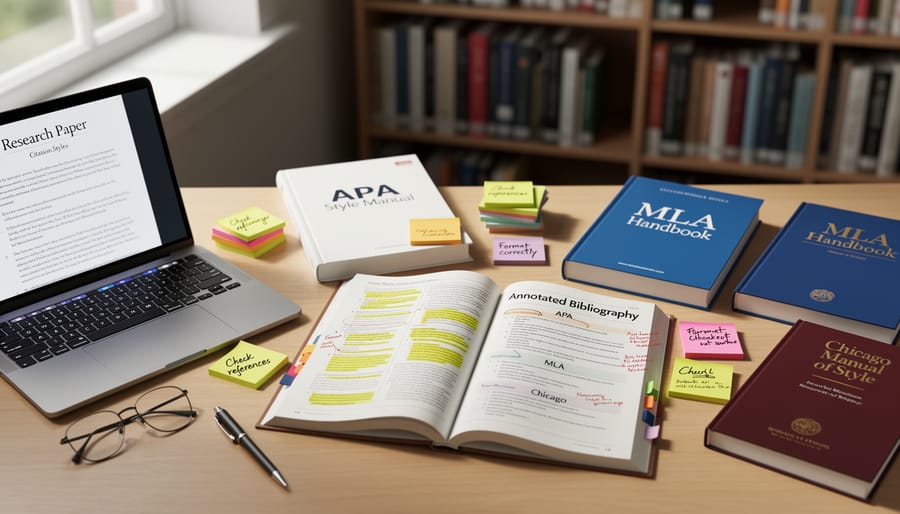
APA: The Social Sciences Standard
APA (American Psychological Association) style is the go-to format for social sciences, education, and psychology fields. If you’re creating annotated bibliographies for clients in these areas, mastering APA will open doors to more opportunities.
The basic APA citation starts with the author’s last name, followed by initials, publication year in parentheses, title in sentence case, and publication information. For example: Smith, J. (2023). Understanding research methods. Academic Press. Your annotation follows immediately after, typically in a new paragraph.
What makes APA unique is its focus on publication dates, reflecting how the social sciences value current research. You’ll also notice that only the first word of titles gets capitalized, along with proper nouns and the first word after a colon.
Here’s good news for freelance writers: once you’ve formatted a few APA citations, the pattern becomes second nature. Many clients appreciate writers who already understand their preferred citation style, giving you a competitive edge when bidding on projects. Practice with a few examples, and you’ll find APA becomes one of your reliable professional skills.
MLA: The Humanities Go-To
If you’re working in literature, arts, or cultural studies, MLA format is likely your citation standard of choice. The Modern Language Association style emphasizes author names and page numbers, making it easy for readers to locate your sources quickly. In your annotated bibliography, you’ll list each source alphabetically by the author’s last name, followed by a brief summary and evaluation paragraph. Think of it as your chance to show clients you’ve done thorough research while demonstrating your analytical skills. Many Canadian freelance writers find MLA particularly straightforward because it flows naturally with humanities writing. The key is consistency: keep your formatting uniform throughout, indent your annotations properly, and double-check those punctuation details. When you master MLA citations, you’re not just following rules—you’re building credibility and showing respect for the intellectual community you’re joining.
Chicago Style: Academic Depth
Chicago style offers two citation systems: Notes-Bibliography (humanities-focused) and Author-Date (sciences). For annotated bibliographies, you’ll typically use Notes-Bibliography format. Start with the author’s full name (last name first), followed by the title in italics, publication details, and page numbers if relevant. Your annotation appears as a new paragraph beneath each citation. Chicago style appreciates thorough documentation, making it ideal when you’re building credibility with academic clients. The format’s flexibility allows you to showcase your research depth while maintaining professional standards. Many Canadian universities prefer Chicago style, so mastering it opens doors to educational writing opportunities. Remember, consistent formatting throughout your bibliography demonstrates attention to detail—a quality that sets successful freelance writers apart. When you cite accurately, you’re not just following rules; you’re building trust with both sources and readers, strengthening your reputation as a reliable professional in the writing industry.
The Ethics of Accurate Attribution
Avoiding Accidental Plagiarism
Accidental plagiarism happens more often than you might think, but the good news is it’s entirely preventable with a few smart habits. When you’re working on client projects or building your portfolio, protecting your reputation starts with careful attribution.
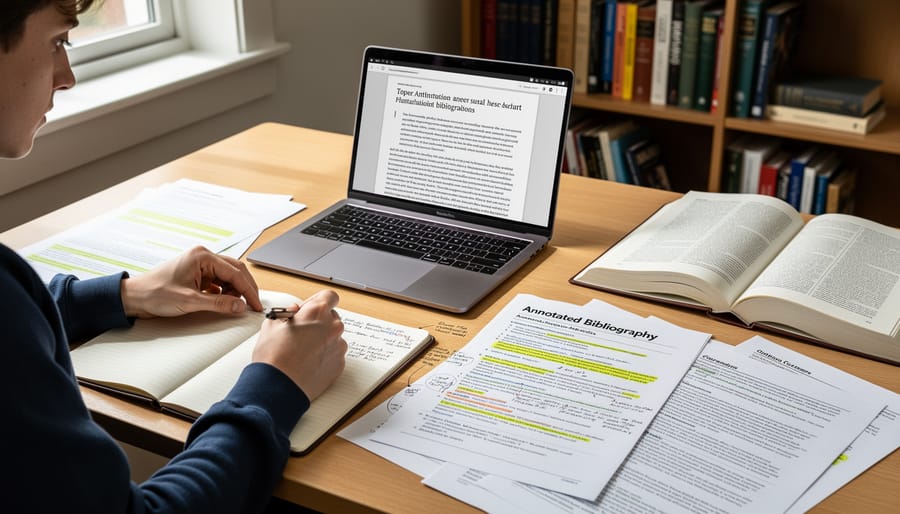
First, take detailed notes while researching. Always record the source information immediately, including author names, publication dates, and page numbers. This simple step saves you from scrambling later to remember where an idea came from. Consider using different colored highlights or note categories to distinguish between direct quotes, paraphrased content, and your original thoughts.
When paraphrasing, don’t just swap out a few words. Master proper paraphrasing techniques by completely restructuring sentences and expressing ideas in your own voice while still citing the original source. A helpful test: put the source material away and write from memory, then check back to ensure accuracy.
Use quotation marks generously when copying exact phrases during research. Even common knowledge in your field might need citation if you’re writing for audiences unfamiliar with the topic. When in doubt, cite it out.
Finally, run your work through plagiarism detection tools before submission. These tools catch unintentional similarities and give you peace of mind that your work is original and properly attributed.
When to Cite and What to Include
Understanding when to cite can feel confusing at first, but the rules are clearer than you might think. Always cite direct quotes, paraphrased ideas, statistics, research findings, and any information that isn’t common knowledge. If you learned it from a specific source rather than knowing it generally, cite it.
You don’t need to cite widely known facts like “Canada has ten provinces” or information you’ve gathered through your own original research and interviews. Your own analysis and conclusions are yours alone and shouldn’t be cited.
Here’s a helpful tip from successful freelance writers: when in doubt, cite it. It’s better to over-cite than risk plagiarism accusations. This approach has saved countless writers from ethical complications and helped them build strong reputations with clients.
Each citation should include enough information for readers to locate your source. Typically, this means author names, publication dates, titles, and page numbers when applicable. Different citation styles arrange these elements differently, but the goal remains consistent: transparency and traceability. By following these guidelines, you’re not just protecting yourself—you’re contributing to a community of writers who value integrity and professional excellence.
Common Citation Errors Freelance Writers Make
We all make mistakes—it’s part of the learning journey! The good news is that most citation errors in annotated bibliographies are easy to fix once you know what to look for. Let’s explore the most common slip-ups freelance writers encounter and how to address them with confidence.
One of the biggest mistakes is inconsistent formatting throughout the bibliography. You might start with APA style for the first few entries, then accidentally switch to MLA halfway through. This happens especially when you’re working on multiple client projects that require different citation styles. The solution? Create a style guide reference sheet for each project and double-check every entry against it before submission. Consistency shows professionalism and attention to detail that clients truly value.
Another frequent error is incomplete citation information. Missing publication dates, page numbers, or DOIs can undermine your credibility. When sources don’t provide all the information you need, don’t panic. Instead, note what’s unavailable using phrases like “n.d.” for no date or “n.p.” for no publisher, following your chosen citation style’s guidelines. This transparency demonstrates thoroughness rather than carelessness.
Many writers also struggle with URL formatting and access dates for online sources. Some citation styles require access dates while others don’t, and URLs should typically appear without hyperlink formatting in formal bibliographies. Take a moment to verify your style guide’s specific requirements for digital sources—this small step prevents confusion.
Annotation length and depth present another challenge. Some writers create annotations that are too brief, offering only one or two sentences, while others write lengthy paragraphs that belong in the paper itself. Aim for 150-200 words that summarize the source, evaluate its credibility, and explain its relevance to your work. This balanced approach serves both you and your readers effectively.
Finally, forgetting to alphabetize entries or using incorrect punctuation marks happens more often than you’d think, especially when you’re working under tight deadlines. A quick proofread focusing solely on alphabetical order and punctuation can catch these errors before they reach your client.
Remember, every successful freelance writer has made these mistakes at some point. What sets professionals apart is their commitment to learning from errors and implementing systems to prevent them. You’re building valuable skills that will serve your writing career for years to come.
Tools and Resources That Make Citations Easier
Good news: you don’t need to master citations on your own. Several reliable tools can help you create accurate citations quickly, saving you time and reducing stress on tight deadlines.
Citation generators are your first line of defense. Zbib.org offers a completely free, user-friendly interface that supports multiple citation styles. Simply enter a URL, ISBN, or DOI, and it generates your citation instantly. Cite This For Me and Citation Machine provide similar services with free basic versions that cover most freelance writing needs. While these tools are incredibly helpful, always double-check the output against official style guides, as automated systems occasionally miss formatting nuances.
Speaking of style guides, bookmark the official resources. The Purdue Online Writing Lab (OWL) remains the gold standard for free, comprehensive guidance on APA, MLA, and Chicago styles. Their examples are clear and regularly updated. For Canadian-specific contexts, the Canadian Guide to Uniform Legal Citation (McGill Guide) is essential for any legal or policy writing projects.
Your local library provides another valuable resource that many writers overlook. Most Canadian public libraries offer free access to premium databases and citation management software like RefWorks or EndNote through their digital services. These professional tools help you organize research and generate bibliographies automatically.
For verification, cross-reference your citations using the original source whenever possible. If you’re citing a journal article, visit the publication’s website to confirm author names, publication dates, and article titles match exactly.
Many successful freelance writers combine these tools strategically. Use generators for speed, verify against style guides for accuracy, and maintain a personal reference file of correctly formatted examples from past projects. This three-pronged approach builds both efficiency and confidence in your citation practices.
Building Your Citation Checklist
Before you submit your annotated bibliography, take a moment to run through this practical checklist. It’ll save you from common oversights and ensure your work reflects the professionalism clients expect.
Start by verifying that every source in your annotations appears in your citations, and vice versa. Nothing should be orphaned. Next, confirm you’ve used the correct citation style throughout. If your client requested APA, double-check those publication dates are in parentheses and titles are properly capitalized.
Review each citation for completeness. Does every entry include all required elements like author names, publication dates, titles, and retrieval information? Missing DOIs or URLs can undermine your credibility. Then, examine your paraphrasing carefully. Read your annotations against the original sources to ensure you’ve genuinely restated ideas in your own words rather than just shuffling phrases around.
Check that you’ve given credit where it’s due. Every idea, statistic, or concept that isn’t common knowledge needs attribution. Finally, proofread for consistency in formatting, punctuation, and spacing.
Toronto-based freelancer Maya Chen shares her experience: “I used to rush through citations, thinking they were just busywork. After creating a personal checklist and using it religiously, my client feedback improved dramatically. One editor specifically praised my attention to detail, which led to ongoing contracts.”
This checklist becomes second nature with practice, transforming citation work from a chore into a confidence builder. Your thoroughness demonstrates respect for intellectual property and sets you apart in a competitive marketplace.

Mastering citation standards might feel overwhelming at first, but here’s the good news: this skill becomes significantly easier with practice. Every annotated bibliography you create strengthens your understanding of proper attribution, and soon you’ll find yourself citing sources almost automatically. Think of it as building muscle memory—the more you do it, the more natural it becomes.
The professional value of getting citations right cannot be overstated. Clients quickly recognize writers who demonstrate attention to detail and commitment to ethical standards in bibliographies. This expertise sets you apart in a competitive marketplace, leading to repeat clients, better-paying projects, and stronger professional relationships. Many successful freelance writers report that their reputation for ethical, accurate work became their greatest marketing tool.
Consider your investment in learning proper citation practices as a career-building step. Writers who consistently deliver ethically sound, properly cited work position themselves as trustworthy professionals worth premium rates. You’re not just avoiding plagiarism—you’re creating a competitive advantage that will serve your freelance career for years to come. Start practicing today, and watch your confidence and opportunities grow.