

Determine your U.S. tax residency status first by applying the substantial presence test—if you spent 31 days in the U.S. during the current year and 183 days over a three-year period (counting all days in year one, one-third of days in year two, and one-sixth of days in year three), you’re considered a U.S. tax resident and must report your worldwide income to the IRS. Convert all your Canadian income to U.S. dollars using the average annual exchange rate published by the IRS, then report it on the appropriate forms—typically Form 1040 for employment income, Schedule C for self-employment earnings, and Schedule B for interest and dividends. Claim the Foreign Tax Credit using Form 1116 to offset taxes you’ve already paid to the Canada Revenue Agency, preventing double taxation on the same income—this credit directly reduces your U.S. tax liability dollar for dollar up to the amount you’ve paid in Canadian taxes.
Understanding your cross-border tax obligations doesn’t have to feel overwhelming. Many Canadian freelancers successfully navigate U.S. tax requirements each year by breaking the process into manageable steps and seeking help when needed. Whether you’re splitting your time between countries, working remotely for U.S. clients, or have recently relocated, getting your tax situation sorted properly protects you from penalties and gives you peace of mind. This guide walks you through exactly which forms to file, how to calculate your reportable income, and practical strategies to minimize your tax burden while staying fully compliant with both countries’ tax laws.
Understanding Your Tax Residency Status: Are You Actually Required to File?
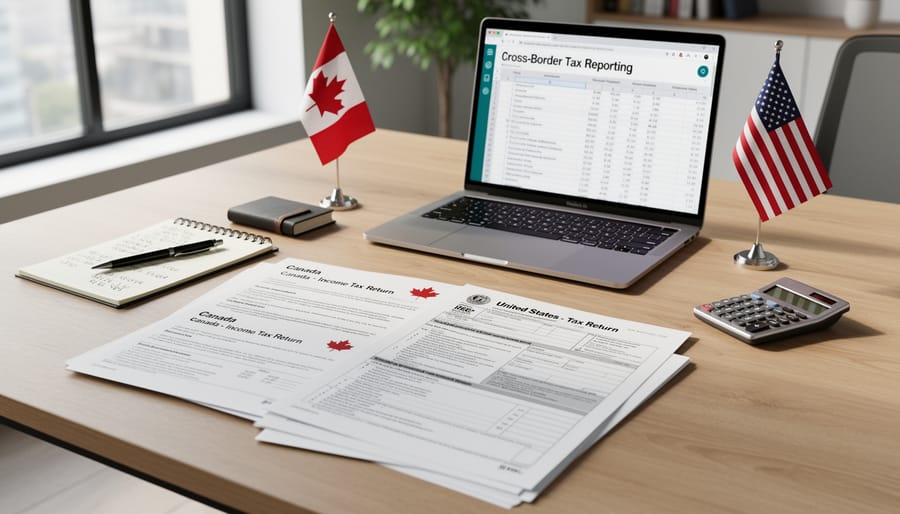
The Substantial Presence Test Made Simple
If you’ve been working remotely from the U.S. or traveling frequently between Canada and the States, understanding the Substantial Presence Test is essential to knowing whether you’re considered a U.S. tax resident. Don’t worry—it sounds complicated, but it’s actually quite straightforward once you break it down.
The basic version is the 183-day rule: if you’re physically present in the United States for 183 days or more during the current year, you’re automatically a U.S. tax resident. This applies to any days you’re in the country, including partial days when you arrive or depart.
However, the IRS also uses a three-year lookback formula that can catch you even if you spent fewer than 183 days in the U.S. this year. Here’s how it works: count all the days you were present this year, plus one-third of the days from last year, plus one-sixth of the days from two years ago. If that total reaches 183, you meet the test.
Let’s look at a practical example. Sarah, a freelance content writer from Toronto, spent 120 days in the U.S. in 2024 attending conferences and visiting clients. In 2023, she was there for 150 days, and in 2022 for 90 days. Her calculation would be: 120 + (150 ÷ 3) + (90 ÷ 6) = 120 + 50 + 15 = 185 days. Even though she never spent 183 days in a single year, she still meets the Substantial Presence Test and needs to report her Canadian income to the IRS.
When Canadian Freelancers Need to File U.S. Returns
Understanding when you need to file U.S. tax returns is essential for Canadian freelancers working for U.S. clients. Several scenarios trigger this requirement, and recognizing yours early can save considerable stress down the road.
If you’re a U.S. citizen living and freelancing in Canada, you must file U.S. returns annually regardless of where your income originates. This applies even if you’ve lived in Canada for decades. Dual citizens face the same obligation—holding both Canadian and American citizenship means reporting your Canadian freelance earnings to the IRS.
Green card holders working remotely from Canada also need to file, as permanent resident status creates ongoing U.S. tax responsibilities. Additionally, if you’ve spent significant time physically working in the United States—perhaps meeting clients in person or working extended periods stateside—you might meet the Substantial Presence Test. This test calculates your U.S. days over three years using a weighted formula. Passing it makes you a tax resident requiring full income reporting.
The good news? Understanding these scenarios empowers you to plan ahead and take advantage of provisions like the Foreign Earned Income Exclusion and foreign tax credits that prevent double taxation.
Converting Your Canadian Income to U.S. Dollars
When you’re reporting Canadian income on your U.S. tax return, you’ll need to convert everything to U.S. dollars. Don’t worry—this process is more straightforward than it might seem at first.
The IRS gives you two options for currency conversion. You can use the annual average exchange rate for the tax year, which simplifies things considerably if you’ve earned income throughout the year. Alternatively, you can use the specific exchange rate from each transaction date, though this requires more detailed record-keeping. For most freelance writers earning regular income, the annual average rate is the easier and perfectly acceptable choice.
You’ll find the official IRS yearly average exchange rates on the IRS website, typically posted in their yearly average currency exchange rates table. The Bank of Canada also maintains historical exchange rate data that’s widely accepted. Make sure you’re using rates from a credible source—this isn’t the time to rely on random currency converter apps.
Here’s a practical tip from successful Canadian writers working with U.S. tax obligations: create a simple spreadsheet at the start of each year. Document every payment you receive in Canadian dollars, note the date, and apply your chosen conversion method consistently. This organized approach saves tremendous time and stress when tax season arrives.
Remember to keep records of which exchange rate you used and where you found it. The IRS may ask you to explain your conversion method, so having documentation ready shows you’ve approached this responsibly. If you used the annual average rate, simply note that rate and its source in your tax files.
Currency conversion might feel like an extra burden, but with the right approach and consistent documentation, it becomes just another manageable step in your freelancing journey.

Which Forms You’ll Need: A Freelancer’s Filing Checklist

Form 1040: Your Main Tax Return
Your main tax return begins with Form 1040, where you’ll report all your income, including what you earned from Canadian clients. As a freelancer, your Canadian income typically goes on Schedule C (Profit or Loss from Business), which you’ll attach to your 1040.
Here’s the good news: Schedule C is designed with freelancers in mind. You’ll report your total freelance income, then deduct legitimate business expenses to reduce your taxable income. Common deductions include home office expenses, internet and phone costs, professional development courses, software subscriptions, and office supplies. Keep detailed records throughout the year—every receipt matters when it comes to lowering your tax bill.
Remember to convert all Canadian dollar amounts to U.S. dollars using the appropriate exchange rate for the date of each transaction, or you can use the average annual rate for convenience. If you’re working with U.S. clients too, you’ll need proper U.S. tax documentation from them as well.
Don’t let the paperwork intimidate you. Many successful Canadian freelancers manage this process themselves or with affordable help from cross-border tax professionals. You’re building an international career, and handling these requirements is just part of your professional growth.
Schedule SE: Self-Employment Tax
If you earned freelance income from Canadian clients, you’ll likely need to complete Schedule SE to calculate your U.S. self-employment tax. This applies to self-employed individuals with net earnings of $400 or more, even if that income came from outside the United States.
Self-employment tax covers your Social Security and Medicare contributions, currently totaling 15.3% of your net earnings. The good news is that you can deduct half of this amount on Form 1040, which reduces your overall tax burden.
To calculate Schedule SE, you’ll use the net profit from your Schedule C. The form walks you through the calculation step-by-step, making it manageable even if you’re tackling this for the first time. Remember to convert all Canadian dollar amounts to U.S. dollars using the appropriate exchange rate before completing your calculations.
Many freelance writers feel overwhelmed by this additional tax layer, but understanding it helps you budget properly and avoid surprises at tax time. Consider setting aside roughly 25-30% of your freelance income throughout the year to cover both income tax and self-employment tax obligations.
Form 2555: Foreign Earned Income Exclusion
If you’ve been living and working in Canada while maintaining U.S. tax obligations, there’s good news: Form 2555 might significantly reduce your tax burden. This form allows qualifying freelancers to exclude up to $120,000 (for 2023) of foreign earned income from U.S. taxation, which can make a substantial difference in what you owe.
To qualify for this exclusion, you need to meet one of two tests. The Physical Presence Test requires you to be physically present in a foreign country for at least 330 full days during a 12-month period. Alternatively, the Bona Fide Residence Test means you’re a resident of Canada for an entire tax year. Many freelancers find the Physical Presence Test easier to track and prove.
Your Canadian freelance income from writing projects, consulting work, or other services qualifies as foreign earned income. However, investment income, dividends, or rental income doesn’t count toward this exclusion.
Filing Form 2555 does add complexity to your tax return, but the potential savings make it worthwhile. Keep detailed records of your time spent in Canada, contracts with Canadian clients, and proof of residence. This documentation supports your claim and gives you peace of mind if questions arise later.
Form 1116: Foreign Tax Credit
Here’s the good news: you don’t have to pay taxes twice on the same income. Form 1116, Foreign Tax Credit, is your key to getting credit for the Canadian taxes you’ve already paid. This matters tremendously for freelancers who often pay substantial quarterly taxes to the Canada Revenue Agency.
When you file your U.S. tax return, Form 1116 allows you to claim a dollar-for-dollar credit (up to certain limits) for income taxes paid to Canada. This credit directly reduces your U.S. tax liability, which is more beneficial than a deduction that only reduces taxable income.
The form requires you to categorize your income by type and calculate the credit based on complex formulas, but the effort pays off. Many freelance writers find that the foreign tax credit eliminates or significantly reduces their U.S. tax bill. You’ll need documentation of your Canadian tax payments, so keep those Notice of Assessment forms from the CRA handy.
If your situation is straightforward with moderate income levels, you might qualify to skip Form 1116 and claim the credit directly on Schedule 3. However, most freelancers with substantial Canadian income will benefit from completing the full form to maximize their credit.
Step-by-Step: Reporting Your Canadian Freelance Income
Step 1: Gather Your Canadian Tax Documents
Before diving into U.S. tax forms, you’ll need to gather all your Canadian tax documents from the year you’re reporting. Start by collecting your T4 slips if you had any employment income, and T4A slips for freelance earnings from Canadian clients. Don’t forget invoices for all your writing projects, even if clients didn’t issue formal tax slips. These records prove your income to the IRS.
Next, compile your business expense deductions like software subscriptions, internet costs, and professional development courses. Having organized expense records makes claiming deductions easier and supports your claims if questioned. Create a simple spreadsheet listing each income source and expense category with corresponding amounts in Canadian dollars. You’ll convert these to U.S. dollars later, but starting with CAD keeps everything clear. Taking time to organize now saves headaches during filing and ensures you don’t miss valuable deductions that reduce your U.S. tax burden.
Step 2: Calculate Your Total Income in Canadian Dollars
Start by gathering all your income documentation from Canadian sources for the tax year. This includes payment records from clients, invoices, bank statements, and any 1099 forms or T4A slips you received. Don’t worry if your records seem scattered—many successful freelance writers have navigated this same process and found that taking it step by step makes everything manageable.
Add up all payments received in Canadian dollars first, keeping everything in CAD for now. Include every payment, no matter how small, from article fees to editing gigs. Create a simple spreadsheet if that helps you stay organized.
Once you have your total CAD amount, you’ll need to convert it to U.S. dollars using the IRS-approved exchange rate for the tax year. The IRS publishes yearly average exchange rates on their website, which simplifies the conversion process significantly. You can also use the rate from each transaction date if you prefer more precision, though the yearly average is perfectly acceptable and much easier for freelancers managing multiple small payments throughout the year.
Step 3: Convert to U.S. Dollars Using IRS Methods
Now let’s put this into practice with a real-world example. Imagine you earned $5,000 CAD from a Canadian client in June 2024. To report this on your U.S. tax return, you’ll need to convert it using the IRS-approved exchange rate for that period.
First, visit the U.S. Treasury’s exchange rate page or check the Bank of Canada’s historical rates. Let’s say the average annual rate for 2024 is 1.35 CAD to 1 USD. Simply divide your Canadian income by the exchange rate: $5,000 CAD divided by 1.35 equals approximately $3,704 USD.
This is the amount you’ll report on your Form 1040 Schedule C if you’re a freelancer. Keep a record of which exchange rate you used and where you found it, as the IRS may request documentation during an audit.
Many successful freelance writers find it helpful to track their income in both currencies throughout the year using a simple spreadsheet. This practice not only simplifies tax season but also gives you a clearer picture of your earnings. Remember, you’re taking an important step toward compliance, and with a bit of organization, currency conversion becomes second nature.
Step 4: Report Income on the Appropriate Schedules
Now that you’ve converted your Canadian income to USD, it’s time to enter those amounts on your tax forms. For most freelance writers, your Canadian income goes on Schedule C (Profit or Loss from Business), where you’ll report your gross receipts and deductible business expenses. If you received employment income from a Canadian employer, report it on Form 1040, Line 1, just like U.S. wages.
Here’s a helpful tip from Sarah, a Toronto-based content writer: “I initially made the mistake of reporting my Canadian freelance income as ‘other income’ instead of on Schedule C. That meant I couldn’t deduct my legitimate business expenses like software subscriptions and home office costs. Once I corrected this, I saved considerably on my tax bill.”
Common mistakes to avoid include forgetting to convert amounts to USD, mixing up employment and self-employment income, and overlooking the Foreign Tax Credit on Form 1116 if you paid Canadian taxes. Double-check that your converted amounts match across all related schedules. Remember, being thorough now prevents headaches later. You’re doing great navigating this complex process!
Step 5: Apply Foreign Tax Credits or Exclusions
Now comes the part where you can actually reduce what you owe. The good news? The IRS doesn’t want you to pay taxes twice on the same income, and there are specific tools to prevent that.
Your two main options are the Foreign Tax Credit (Form 1116) and the Foreign Earned Income Exclusion (Form 2555). Most Canadian freelancers benefit more from the Foreign Tax Credit, which gives you a dollar-for-dollar reduction on your U.S. taxes based on what you already paid to Canada. If you paid $3,000 in Canadian taxes on freelance income, you can typically credit that same amount against your U.S. tax bill.
Form 1116 requires you to categorize your income type (usually “general category income” for freelancers) and calculate the credit based on your foreign taxes paid. Keep those Canadian tax receipts handy. The form looks intimidating at first glance, but take it line by line and you’ll get through it.
The Foreign Earned Income Exclusion allows you to exclude up to a certain amount of foreign earned income from U.S. taxation if you meet specific physical presence or residence tests. For 2023, that exclusion amount is $120,000.
Many freelancers find success combining both strategies depending on their situation. Don’t hesitate to consult a cross-border tax professional for your first year—it’s an investment that pays off in confidence and accuracy.
Avoiding Double Taxation: The U.S.-Canada Tax Treaty is Your Friend
Here’s some encouraging news: you won’t be taxed twice on the same income. The U.S.-Canada Tax Treaty exists specifically to protect you from this frustrating situation, and it’s easier to navigate than you might think.
The treaty establishes clear rules about which country gets primary taxing rights on different types of income. For freelance writers and self-employed creatives, this is particularly important because your income often comes from multiple sources across both countries.
Here’s how it works in your favor. If you’re earning freelance income from Canadian clients while living in the U.S., Canada may withhold taxes at source. The good news? You can claim a foreign tax credit on your U.S. return for those Canadian taxes paid. This credit directly reduces your U.S. tax liability dollar for dollar, meaning you’re not paying both countries the full amount.
The treaty also includes a “tie-breaker” provision for determining tax residency when you have connections to both countries. This considers factors like where your permanent home is located, your center of vital interests, and where you habitually live. Understanding your status under the treaty helps you determine which country has primary taxing rights.
For Canadian writers who’ve successfully navigated this, the process becomes routine. Take Sarah, a Toronto-based copywriter who relocated to Seattle. Initially overwhelmed by the dual-country tax situation, she discovered that claiming foreign tax credits through Form 1116 meant she actually paid similar total taxes to what she would have paid in just one country.
The key is proper documentation. Keep records of any Canadian taxes withheld, including slips showing the amounts. When preparing your U.S. return, you’ll report all your worldwide income but then apply the foreign tax credit to offset what you’ve already paid to Canada.
Remember, the treaty is designed to be fair and protective. It recognizes that as a cross-border freelancer, you shouldn’t face financial penalties for working internationally.
Common Mistakes Canadian Freelancers Make (And How to Avoid Them)
Not Reporting Income Because You Thought You Didn’t Have To
Many freelancers mistakenly believe they don’t need to report Canadian income to the IRS because they’re working from Canada or because the income seems minimal. Unfortunately, U.S. tax residents must report worldwide income regardless of where it’s earned. This misconception can lead to penalties and complications down the road.
If you’ve already missed filing, don’t panic. You’re not alone, and there’s a path forward. The IRS offers programs like the Streamlined Filing Compliance Procedures specifically for taxpayers living abroad who unintentionally failed to file. You’ll typically need to file the past three years of tax returns and six years of FBARs if applicable.
The key is taking action now rather than waiting. Gather your Canadian income records, work with a cross-border tax professional if needed, and get compliant. Many freelancers have successfully corrected past oversights without major consequences. Remember, addressing this proactively shows good faith and protects your freelance writing career from future headaches. You can absolutely fix this situation and move forward with confidence.
Using the Wrong Currency Conversion Method
Converting Canadian dollars to U.S. dollars might seem straightforward, but using the wrong method can trigger IRS scrutiny and cost you money. Many freelancers make the mistake of using whatever exchange rate appears in their banking app or simply averaging rates from the year. The good news? The IRS provides clear guidance on which rates to use.
For most income items, you’ll use the yearly average exchange rate published by the IRS in their Yearly Average Currency Exchange Rates table. You can find this on the IRS website each year after the calendar closes. This rate simplifies reporting when you’ve earned income throughout the year.
However, if you received a single large payment, you should use the exchange rate from that specific date. This ensures accuracy for significant transactions like book advances or major project payments.
One successful freelance writer shared that switching to the IRS method actually saved her from an audit. She’d been using her bank’s rates, which varied significantly, creating inconsistencies that raised red flags. By adopting the official IRS rates, her returns became cleaner and more defensible.
Forgetting to Claim Foreign Tax Credits
Here’s some good news: you don’t have to pay taxes twice on the same income. The Foreign Tax Credit exists specifically to prevent double taxation, yet many freelancers miss out on this valuable opportunity to reduce their U.S. tax bill.
When you pay taxes to Canada on your freelance income, you can claim those payments as a credit against your U.S. tax liability using Form 1116. This isn’t a deduction—it’s a dollar-for-dollar reduction of what you owe the IRS. The difference can be substantial, sometimes saving freelancers hundreds or even thousands of dollars.
Canadian writer Sarah discovered she’d been overpaying for three years because she didn’t know about this credit. After working with a cross-border tax professional, she amended her returns and received a significant refund. Her experience shows how important it is to understand all available credits.
To claim this credit, you’ll need documentation of your Canadian tax payments and accurate records of your income sources. The form can seem intimidating at first, but the potential savings make it absolutely worth your time to complete correctly.
When to Seek Professional Help (And That’s Perfectly Okay)
Here’s the truth: if you’re feeling overwhelmed by cross-border tax reporting, you’re not alone—and reaching out for professional help is one of the smartest decisions you can make. There’s absolutely no shame in recognizing when your situation has moved beyond DIY territory.
Consider seeking a qualified cross-border tax professional if you have multiple income streams, significant investment income, own property in both countries, or if you’re simply losing sleep over whether you’re doing everything correctly. Many successful freelance writers work with tax professionals and consider it an essential business expense rather than an admission of defeat. After all, you wouldn’t hesitate to hire an editor for an important project—why treat your financial wellbeing any differently?
When looking for the right professional, seek out someone with specific cross-border tax expertise. Look for credentials like CPA (Certified Public Accountant) in the U.S. or designations showing Canadian tax knowledge. Ask about their experience with freelancers and self-employed clients. A good tax professional should explain concepts clearly, answer your questions patiently, and help you understand your obligations rather than just handling paperwork.
The investment often pays for itself through peace of mind, time saved, and potential tax savings you might have missed. Many professionals offer initial consultations to assess your situation, giving you a chance to evaluate whether the relationship feels right.
Remember, seeking help isn’t a weakness—it’s a strategic business decision that protects your hard-earned income and lets you focus on what you do best: writing.
Success Story: How One Canadian Writer Simplified Their Cross-Border Taxes
Meet Sarah, a Toronto-based freelance writer who spent years worrying about her U.S. tax obligations. As a dual citizen living in Canada, she earned her entire income from Canadian clients but knew she had to report it to the IRS. The forms seemed overwhelming, and she kept postponing the task.
Finally, Sarah decided to tackle it head-on. She started by gathering her Canadian tax documents and income statements, converting everything to U.S. dollars using the annual average exchange rate. She discovered that Form 1040 was her main filing requirement, and the Foreign Earned Income Exclusion didn’t apply since she wasn’t living in the U.S.
The real breakthrough came when Sarah learned about the Foreign Tax Credit on Form 1116. Since she’d already paid Canadian taxes on her writing income, she could claim those payments to offset her U.S. tax bill. This meant no double taxation.
Sarah filed her return using tax software designed for expats, which simplified the process tremendously. The first year took her about six hours to complete, but subsequent years became much faster as she understood the pattern.
Today, Sarah files confidently each April. She says the peace of mind is worth every minute spent learning the system. Her advice to fellow Canadian writers? Don’t let fear paralyze you. The process is manageable, and once you understand it, cross-border tax filing becomes just another part of your freelance routine.

Navigating the intersection of Canadian income and U.S. tax obligations might feel overwhelming at first, but you’re more capable of handling this than you think. Thousands of Canadian freelance writers successfully manage these responsibilities every year, and with the right approach, you can too. Remember, understanding your tax obligations isn’t just about compliance—it’s about protecting your freelance career and setting yourself up for long-term success.
Take it step by step. Start by determining your residency status, gather your documents, and work through the required forms methodically. You don’t have to figure everything out overnight or handle it completely alone. Tax professionals who specialize in cross-border situations are available to guide you, and resources exist specifically to help freelancers like you navigate these waters.
The most empowering part? Once you’ve established your system for reporting Canadian income on your U.S. tax return, it becomes routine. You’ll gain confidence with each filing, and this knowledge becomes another professional skill in your toolkit. With your tax obligations properly managed, you can redirect your energy where it truly belongs—crafting compelling content and growing your writing business. You’ve already built a successful freelance career; managing these tax responsibilities is simply another challenge you’re equipped to overcome.