

Track your billable hours daily using a simple spreadsheet or time-tracking app like Toggl or Harvest. Record every writing session, client call, and administrative task to understand where your energy actually goes. Most freelance writers discover they spend only 40-60% of their workday on paid writing, revealing opportunities to either bill more efficiently or eliminate time-draining activities.
Calculate your effective hourly rate each month by dividing total earnings by total hours worked, including pitching, invoicing, and research time. This metric tells you whether that “high-paying” client actually compensates fairly when you factor in revision rounds and communication overhead. If your effective rate falls below your target, you’ll know exactly which clients or project types to phase out.
Monitor your pitch-to-conversion ratio by tracking how many queries you send versus assignments you land. A healthy conversion rate sits around 20-30% for established writers, while newer freelancers might see 5-10%. When your ratio drops, you can adjust your pitching strategy, target different publications, or refine your query letters before wasting weeks on ineffective outreach.
Set weekly revenue goals and review them every Friday afternoon. Breaking annual income targets into manageable weekly chunks transforms an overwhelming number into achievable milestones. This practice helps you spot slow periods early enough to ramp up pitching or take on short-term projects before cash flow becomes critical.
These measurement habits transform vague productivity concerns into concrete data that guides smarter business decisions and sustainable growth.
Why Most Freelance Writers Track the Wrong Things

The Word Count Trap
Many freelance writers fall into the trap of tracking word count as their primary productivity metric, but this approach can actually work against you. A 2,000-word blog post that pays $200 generates the same income as a 500-word email sequence that pays $200—yet the word count suggests one is four times more productive than the other.
The real problem? Word count doesn’t account for research time, revision rounds, client communication, or the value you’re delivering. You might write 5,000 words in a day on low-paying content mill assignments while staying productive, but earn less than spending that same time crafting a 1,000-word piece for a premium client.
Consider Sarah, a Toronto-based writer who obsessed over daily word counts. She consistently hit 3,000 words per day but struggled financially. When she shifted focus to tracking income per hour instead, she discovered her highest-paying work required fewer words but more strategic thinking. Within three months, she doubled her income while actually writing less.
The takeaway? Words are an output, not an outcome. Track metrics that actually reflect your business success.
Hours Worked Don’t Equal Money Earned
Logging hours feels productive, but it’s only part of your financial picture. You might work eight hours on a blog post and two hours on a web page, but if the blog post paid $100 and the web page paid $200, your hourly rates tell completely different stories. That blog post earned you $12.50 per hour while the web page brought in $100 per hour.
This distinction matters tremendously for your freelance writing business. When you track both time and earnings together, patterns emerge. You’ll discover which clients offer the best return on your time investment and which project types drain hours without adequate compensation. Maybe your feature articles take longer but pay better overall, or perhaps your quick social media packages deliver surprisingly strong hourly rates.
Understanding project profitability helps you make smarter decisions about where to focus your energy. Instead of simply staying busy, you can prioritize work that actually builds your income. Track your hourly rate by project type for at least a month, and you’ll gain clarity on which opportunities deserve your attention and which ones you might want to phase out or renegotiate.
The Five Productivity Metrics That Actually Matter
Your Real Hourly Rate
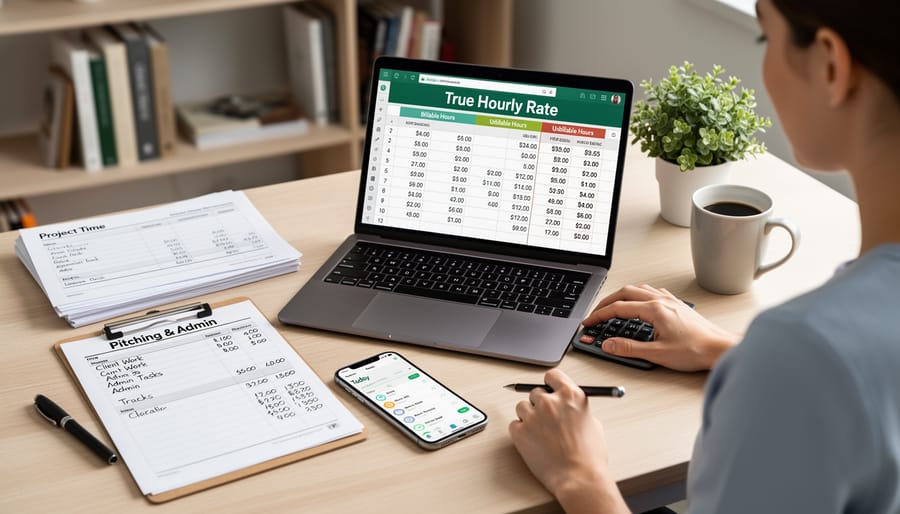
Understanding your real hourly rate is a game-changer for tracking your productivity effectively. Many freelance writers calculate their rate based only on billable writing time, but that doesn’t reflect reality. Your true hourly rate includes all the unbillable hours you invest in your business.
Here’s a simple formula to calculate it: Take your total monthly income and divide it by all hours worked, including pitching, invoicing, editing, client communications, professional development, and administrative tasks.
For example, let’s say you earned $3,000 last month. You spent 40 hours on paid writing assignments, but also invested 15 hours pitching to new clients, 10 hours on revisions and editing, and 10 hours managing emails and invoices. That’s 75 total hours, giving you a real hourly rate of $40 per hour, not the $75 you might have assumed based on writing time alone.
This calculation reveals where your time actually goes and helps you make informed decisions about which clients and projects truly serve your business goals. Track this metric monthly to spot trends and adjust your strategy accordingly.
Income Per Client
Not all clients are created equal when it comes to your bottom line. Tracking your income per client reveals who truly values your work and pays rates that reflect your worth. This metric helps you understand which relationships deserve your best energy and time.
Start by creating a simple spreadsheet listing each client alongside the total revenue they’ve generated over the past six months. Calculate what you’ve earned per project or per hour from each one. You might discover that a client who sends frequent small assignments actually generates more annual income than one with occasional large projects.
This insight is powerful for planning your business growth. When you know your top-earning clients, you can prioritize their deadlines, offer them first access to your availability, and model your ideal client profile after them. It also helps you identify which clients might be draining your resources without adequate compensation.
Consider setting a minimum threshold for client relationships. If someone consistently pays below your target rate without potential for growth, that’s valuable information for making tough decisions about your roster.
Pitch-to-Acceptance Ratio
Tracking your pitch-to-acceptance ratio reveals which opportunities deserve your energy. Simply divide your accepted pitches by total pitches sent, then multiply by 100 for a percentage. If you send 20 pitches monthly and land 4 assignments, that’s a 20% conversion rate—right in line with industry standards.
This metric helps you spot patterns in what works. Maybe pitches to trade magazines convert better than general interest publications, or your health writing pitches outperform tech topics. Use these insights to focus your efforts where they pay off.
Don’t get discouraged by rejection—even successful writers face it regularly. Canadian writer Sarah Thompson increased her acceptance rate from 15% to 35% by analyzing which publications responded positively and tailoring future pitches accordingly. Track where you’re succeeding, refine your approach for publications that aren’t biting, and remember that every no brings you closer to your next yes.
Monthly Recurring Revenue
One of the most valuable metrics for your freelance writing business is Monthly Recurring Revenue (MRR). This tracks income from retainer clients, regular column work, and ongoing contracts that repeat monthly. Knowing your MRR helps you understand your financial foundation and reduces the stress of the feast-or-famine cycle that many freelancers face.
Start by listing all clients who pay you consistently each month. Add up these predictable payments to calculate your baseline income. This number represents your financial safety net and shows how much new work you actually need to pursue each month.
As you build your MRR, you’ll find yourself sleeping better at night. Canadian writer Jenna from Toronto shared that once her retainer work covered her basic expenses, she felt free to pursue passion projects without constant financial anxiety. Aim to gradually increase your MRR by pitching ongoing content needs to existing clients or seeking new retainer arrangements. Even one or two steady clients can transform your freelance experience from unpredictable to sustainable.
Project Turnaround Time
Tracking how long projects take from start to finish is one of the most valuable metrics for growing your freelance writing business. When you know your typical turnaround time for a 1,000-word blog post versus a comprehensive white paper, you can schedule commitments with confidence and avoid the stress of overcommitting.
Start by noting when you accept each assignment and when you submit the final draft. Over time, you’ll spot patterns that help you quote realistic deadlines to clients. Maybe you consistently finish website copy faster than you thought, or perhaps research-heavy articles always take an extra day. This insight transforms how you plan your week.
Understanding your turnaround times also reveals opportunities to increase your income. If you regularly complete projects ahead of schedule, you have room to take on additional work. One Canadian writer discovered she could handle five blog posts weekly instead of three simply by tracking and optimizing her process. That awareness led to a 60 percent income boost without working longer hours. Use this metric to set boundaries, impress clients with dependable delivery, and maximize your earning potential.
Simple Systems to Track Your Metrics (No PhD Required)
The Weekly Check-In Method
Set aside just 15 minutes every Friday afternoon to capture your week’s productivity data. This simple ritual creates accountability without overwhelming your schedule, especially when paired with solid time management strategies.
Start with whatever tool feels most comfortable. Google Sheets works beautifully because it’s free, accessible anywhere, and calculates totals automatically. If you prefer analog, a dedicated notebook works just as well. Create columns for your date, words written, pitches sent, client communications, and income invoiced that week.
During your check-in, simply record the numbers. How many articles did you complete? How many queries went out? What revenue did you generate? This isn’t about judgment—it’s about visibility. One Canadian writer shared that her weekly check-ins revealed she was spending too much time on low-paying clients, prompting her to raise rates and triple her income within six months.
The beauty of this method lies in its simplicity. You’re not tracking every minute of your day or using complicated software. You’re creating a clear snapshot of your freelance business that helps you spot patterns, celebrate progress, and make informed decisions about where to focus your energy next.
Free Tools That Make Tracking Painless
You don’t need fancy software to start tracking your productivity today. Several excellent free tools can help you monitor your writing metrics without spending a dime.
Toggl Track offers a generous free plan perfect for solo freelancers. Simply click to start timing your writing sessions, and the tool automatically organizes your data into visual reports. You’ll quickly see which projects consume most of your time and whether your hourly rates make sense.
For income and expense tracking, Wave provides completely free accounting software designed for small businesses. Canadian freelancers appreciate its straightforward interface and ability to generate professional invoices while keeping tabs on your financial health.
If you prefer simplicity, a basic spreadsheet template works beautifully. Create columns for date, project name, hours worked, words written, and income earned. This low-tech approach gives you complete control and requires no learning curve. Many successful Canadian writers still swear by their customized spreadsheets.
The best tool is the one you’ll actually use consistently. Start with whichever option feels most comfortable, then track your metrics for at least a month. You’ll gain valuable insights into your productivity patterns and identify opportunities to boost both your output and income.
Creating Your Personal Dashboard
Your dashboard should fit on a single page—whether that’s a spreadsheet, a journal page, or a digital tool. Start by selecting 5-7 metrics that matter most to your freelance writing business. For most writers, this includes monthly income, active clients, pitches sent, invoices outstanding, and words written.
Create columns for each week of the month, and dedicate 10 minutes every Friday to filling in your numbers. This weekly rhythm helps you spot patterns quickly—like noticing your income dips when you pitch less, or identifying which clients consistently pay late.
Keep your dashboard simple and visual. Use color coding for at-glance insights: green for goals met, yellow for close, red for needs attention. Many freelancers find success with a basic Google Sheet that takes just minutes to update.
The real power comes from reviewing these numbers weekly. You’ll start recognizing which activities actually drive results and which just feel productive. This clarity helps you streamline your admin work by focusing only on tracking what matters. One Toronto-based writer discovered through her dashboard that guest posting brought her three new clients in two months—insight that completely shifted her marketing strategy.
What Your Numbers Are Trying to Tell You

When to Raise Your Rates
One of productivity tracking’s most valuable benefits is revealing your true worth. When you track time against earnings, you might discover you’re making $15 per hour on projects you thought were lucrative. That’s your signal to raise rates.
The data removes emotion from pricing decisions. Instead of wondering if you deserve more, you have proof. If tracking shows you’re completing articles faster due to improved skills, you’re delivering more value in less time. That efficiency belongs to you, not your client’s budget.
Many Canadian writers successfully use their metrics during rate negotiations. You can confidently say, “My tracking shows I’m delivering quality work efficiently, and my rates haven’t increased in 18 months.” Clients respect evidence-based conversations.
Start reviewing your hourly breakdown quarterly. If most projects fall below your target rate, it’s time to adjust. Remember, raising rates isn’t greedy—it’s recognizing your growing expertise and ensuring your business remains sustainable.
Identifying Your Most Profitable Niche
After tracking your writing activities for a month or two, you’ll have valuable data to analyze. Look at which projects generated the most income per hour worked. Maybe your blog posts earn $50 per hour while technical writing brings in $85. Perhaps social media content feels quick and easy but yields lower rates than long-form articles.
Compare your hourly rates across different clients and project types. You might discover that certain industries pay significantly better or that specific content formats align perfectly with your skills, allowing you to work faster and earn more. This insight is essential for building a sustainable business.
Don’t forget to consider enjoyment alongside profitability. If you love writing case studies and they pay well, that’s your sweet spot! Use this information to gradually shift your focus toward your most profitable niches while phasing out lower-paying work that drains your energy and time.
Spotting Burnout Before It Happens
Your productivity data can be your early warning system for burnout. When you notice your hours creeping up while your output stays flat, or when you’re consistently working evenings and weekends, those numbers are telling you something important. Many freelance writers push through exhaustion, believing more hours equal more success, but your tracking metrics can reveal when you’re running on empty.
Pay attention to patterns like declining writing quality, missed deadlines despite long hours, or taking longer to complete similar projects. These signs often appear in your data before you consciously recognize the problem. If you’re logging twelve-hour days regularly but your income hasn’t increased proportionally, it’s time to reassess. Your metrics might show you’re accepting too many low-paying projects or spending excessive time on administrative tasks.
Use this information constructively. Schedule regular breaks, set firm boundaries around work hours, and consider raising your rates rather than increasing your workload. Remember, sustainable productivity beats short-term hustle every time.
You don’t need to track everything to see results. This week, choose just one or two metrics that resonate with you. Maybe it’s your daily word count and how long projects actually take, or perhaps your income per project and monthly earnings. Start simple, stay consistent, and adjust as you learn what works for your unique writing business.
Remember, productivity tracking isn’t about achieving perfection or comparing yourself to other writers. It’s about gathering the information you need to make smarter decisions about your rates, your clients, and how you spend your precious time. When you understand your numbers, you can confidently say yes to opportunities that truly serve your goals and gracefully decline those that don’t.
Your freelance writing career is yours to shape. By tracking even basic metrics, you’re taking an active role in building a business that’s not only profitable but sustainable for the long haul. You’re moving from guessing to knowing, from reacting to planning. That’s powerful.
So grab a notebook, open a spreadsheet, or download a simple tracking app. Your future self will thank you for the clarity and control you’re creating today. You’ve got this.